

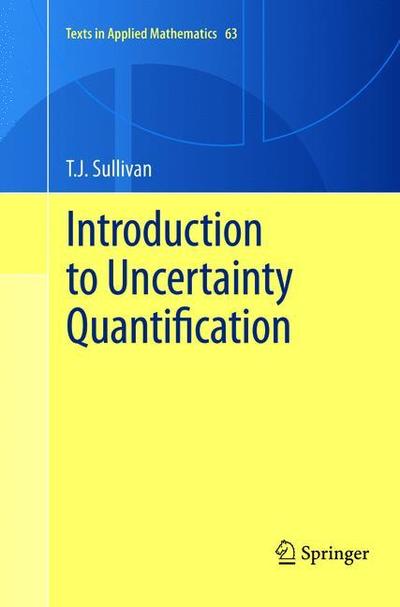
This text provides a framework in which the main objectives of the field of uncertainty quantification (UQ) are defined and an overview of the range of mathematical methods by which they can be achieved. Complete with exercises throughout, the book will equip readers with both theoretical understanding and practical experience of the key mathematical and algorithmic tools underlying the treatment of uncertainty in modern applied mathematics. Students and readers alike are encouraged to apply the mathematical methods discussed in this book to their own favorite problems to understand their strengths and weaknesses, also making the text suitable for a self-study.
Uncertainty quantification is a topic of increasing practical importance at the intersection of applied mathematics, statistics, computation and numerous application areas in science and engineering. This text is designed as an introduction to UQ for senior undergraduate and graduate students with a mathematical or statistical background and also for researchers from the mathematical sciences or from applications areas who are interested in the field.
T. J. Sullivan was Warwick Zeeman Lecturer at the Mathematics Institute of the University of Warwick, United Kingdom, from 2012 to 2015. Since 2015, he is Junior Professor of Applied Mathematics at the Free University of Berlin, Germany, with specialism in Uncertainty and Risk Quantification.
| ISBN: | 9783319794785 |
| Publication date: | 13th March 2019 |
| Author: | TJ Sullivan |
| Publisher: | Springer an imprint of Springer International Publishing |
| Format: | Paperback |
| Pagination: | 342 pages |
| Series: | Texts in Applied Mathematics |
| Genres: |
Probability and statistics Stochastics Numerical analysis Mathematical physics Maths for engineers Optimization |
This text provides a framework in which the main objectives of the field of uncertainty quantification (UQ) are defined and an overview of the range of mathematical methods by which they can be achieved. Complete with exercises throughout, the book will equip readers with both theoretical understanding and practical experience of the key mathematical and algorithmic tools underlying the treatment of uncertainty in modern applied mathematics. Students and readers alike are encouraged to apply the mathematical methods discussed in this book to their own favorite problems to understand their strengths and weaknesses, also making the text suitable for a self-study.Uncertainty quantification is a topic of increasing practical importance at the intersection of applied mathematics, statistics, computation and numerous application areas in science and engineering. This text is designed as an introduction to UQ for senior undergraduate and graduate students with a mathematical or statistical background and also for researchers from the mathematical sciences or from applications areas who are interested in the field.T.
Introduction to Uncertainty Quantification features in the following genres: Probability and statistics, Stochastics, Numerical analysis, Mathematical physics, Maths for engineers, Optimization
Paperback. £49.49, down from the £54.99 cover price. Not Available.
Introduction to Uncertainty Quantification was written by TJ Sullivan and published by Springer an imprint of Springer International Publishing
Introduction to Uncertainty Quantification has 342 pages
Yes it is part of Texts in Applied Mathematics series
£49.49, reduced from £54.99. Not Available.