

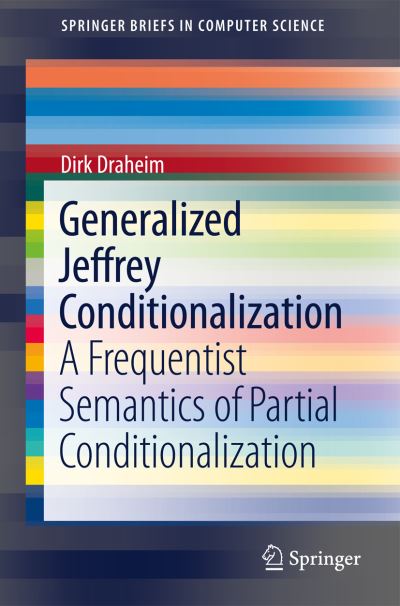
| ISBN: | 9783319698670 |
| Publication date: | 16th November 2017 |
| Author: | Dirk Draheim |
| Publisher: | Springer an imprint of Springer International Publishing |
| Format: | Paperback |
| Pagination: | 106 pages |
| Series: | SpringerBriefs in Computer Science |
| Genres: |
Maths for computer scientists Management decision making Operational research Probability and statistics Mathematical theory of computation Artificial intelligence |
This book provides a frequentist semantics for conditionalization on partially known events, which is given as a straightforward generalization of classical conditional probability via so-called probability testbeds. It analyzes the resulting partial conditionalization, called frequentist partial (F.P.) conditionalization, from different angles, i.e., with respect to partitions, segmentation, independence, and chaining.
Generalized Jeffrey Conditionalization features in the following genres: Maths for computer scientists, Management decision making, Operational research, Probability and statistics, Mathematical theory of computation, Artificial intelligence
Paperback. Not Available.
Generalized Jeffrey Conditionalization was written by Dirk Draheim and published by Springer an imprint of Springer International Publishing
Generalized Jeffrey Conditionalization has 106 pages
Yes it is part of SpringerBriefs in Computer Science series