

| ISBN: | 9783319594323 |
| Publication date: | 20th September 2017 |
| Author: | Lokenath Debnath, Firdous A Shah |
| Publisher: | Birkhauser an imprint of Springer International Publishing |
| Format: | Paperback |
| Pagination: | 220 pages |
| Series: | Compact Textbooks in Mathematics |
| Genres: |
Complex analysis, complex variables Functional analysis and transforms Electronics engineering Digital signal processing (DSP) |
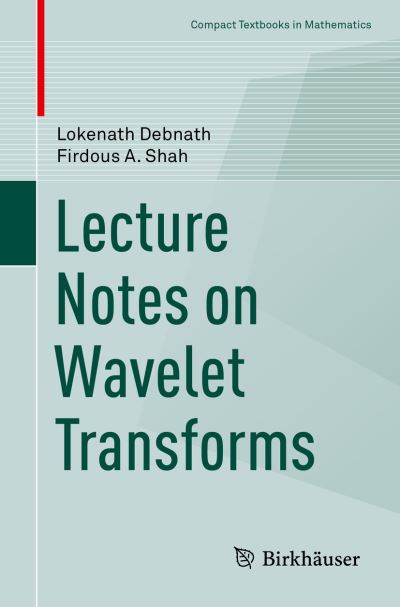
This book provides a systematic exposition of the basic ideas and results of wavelet analysis suitable for mathematicians, scientists, and engineers alike. The primary goal of this text is to show how different types of wavelets can be constructed, illustrate why they are such powerful tools in mathematical analysis, and demonstrate their use in applications.
Lecture Notes on Wavelet Transforms features in the following genres: Complex analysis, complex variables, Functional analysis and transforms, Electronics engineering, Digital signal processing (DSP)
Paperback. £40.49, down from the £44.99 cover price. Not Available.
Lecture Notes on Wavelet Transforms was written by Lokenath Debnath, Firdous A Shah and published by Birkhauser an imprint of Springer International Publishing
Lecture Notes on Wavelet Transforms has 220 pages
Yes it is part of Compact Textbooks in Mathematics series
£40.49, reduced from £44.99. Not Available.