

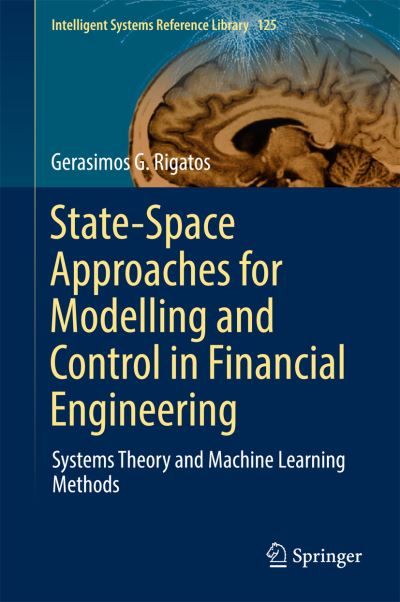
The book conclusively solves problems associated with the control and estimation of nonlinear and chaotic dynamics in ?nancial systems when these are described in the form of nonlinear ordinary di?erential equations. It then addresses problems associated with the control and estimation of ?nancial systems governed by partial di?erential equations (e.g. the Black-Scholes partial differential equation (PDE) and its variants). Lastly it an offers optimal solution to the problem of statistical validation of computational models and tools used to support ?nancial engineers in decision making.
The application of state-space models in ?nancial engineering means that the heuristics and empirical methods currently in use in decision-making procedures for ?nance can be eliminated. It also allows methods of fault-free performance and optimality in the management of assets and capitals and methods assuring stability in the functioning of ?nancial systems to be established.
Coveringthe following key areas of ?nancial engineering: (i) control and stabilization of ?nancial systems dynamics, (ii) state estimation and forecasting, and (iii) statistical validation of decision-making tools, the book can be used for teaching undergraduate or postgraduate courses in ?nancial engineering. It is also a useful resource for the engineering and computer science community
| ISBN: | 9783319528656 |
| Publication date: | 13th April 2017 |
| Author: | Gerasimos G Rigatos |
| Publisher: | Springer an imprint of Springer International Publishing |
| Format: | Hardback |
| Pagination: | 310 pages |
| Series: | Intelligent Systems Reference Library |
| Genres: |
Artificial intelligence Automatic control engineering Cybernetics and systems theory Risk assessment Management and management techniques Optical physics Maths for engineers Electronics engineering |
The book conclusively solves problems associated with the control and estimation of nonlinear and chaotic dynamics in ?nancial systems when these are described in the form of nonlinear ordinary di?erential equations. It then addresses problems associated with the control and estimation of ?nancial systems governed by partial di?erential equations (e.g. the Black-Scholes partial differential equation (PDE) and its variants).
State-Space Approaches for Modelling and Control in Financial Engineering features in the following genres: Artificial intelligence, Automatic control engineering, Cybernetics and systems theory, Risk assessment, Management and management techniques, Optical physics, Maths for engineers, Electronics engineering
Hardback. Not Available.
State-Space Approaches for Modelling and Control in Financial Engineering was written by Gerasimos G Rigatos and published by Springer an imprint of Springer International Publishing
State-Space Approaches for Modelling and Control in Financial Engineering has 310 pages
Yes it is part of Intelligent Systems Reference Library series