

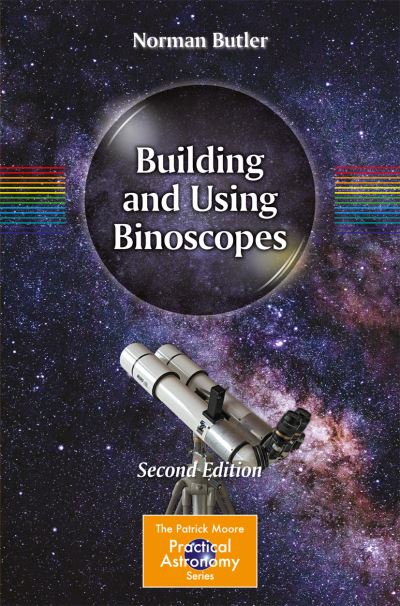
Covering both homemade and commercial products, this book provides the reader with simple and straightforward information about the modeling, building, and use of binoscopes. Binoscopes can be thought of as binoculars enlarged to the size of telescopes - essentially, a combination of the two.
Constructing a binoscope is easier than most people think, but it still demands attention to detail and proper background knowledge. The author goes on to provide additional information about the products currently on the market, should the reader choose to purchase one instead of building it. Lastly, the book also compares binoscopes with telescopes in great detail, outlining the differences the reader can expect to see in the night sky from using both.
The celestial views obtained with a binoscope, compared to a single telescope of the same aperture, are a very different experience.
The new edition emphasizes the obvious advantages of viewing celestial objects through a binoscope. There are also many new photos and additional information on the latest equipment and some very special and rare equipment a collector might be interested in. Newly added cartoons and additional images of beautiful deep sky objects in each of the chapters makes reading the book a more enjoyable experience.
Finally, there is a new comet discovery form and guide to follow for such discoveries, and a complete list of Messier objects for those interested in searching for these.
| ISBN: | 9783319467887 |
| Publication date: | 13th October 2017 |
| Author: | Norman P Butler |
| Publisher: | Springer an imprint of Springer International Publishing |
| Format: | Paperback |
| Pagination: | 386 pages |
| Series: | The Patrick Moore Practical Astronomy Series |
| Genres: |
Astronomy, space and time Laser physics Astronomical observation: observatories, equipment and methods |
Covering both homemade and commercial products, this book provides the reader with simple and straightforward information about the modeling, building, and use of binoscopes. Binoscopes can be thought of as binoculars enlarged to the size of telescopes - essentially, a combination of the two. Constructing a binoscope is easier than most people think, but it still demands attention to detail and proper background knowledge. The author goes on to provide additional information about the products currently on the market, should the reader choose to purchase one instead of building it.
Building and Using Binoscopes features in the following genres: Astronomy, space and time, Laser physics, Astronomical observation: observatories, equipment and methods
Paperback. £40.49, down from the £44.99 cover price. Not Available.
Building and Using Binoscopes was written by Norman P Butler and published by Springer an imprint of Springer International Publishing
Building and Using Binoscopes has 386 pages
Yes it is part of The Patrick Moore Practical Astronomy Series series
£40.49, reduced from £44.99. Not Available.