

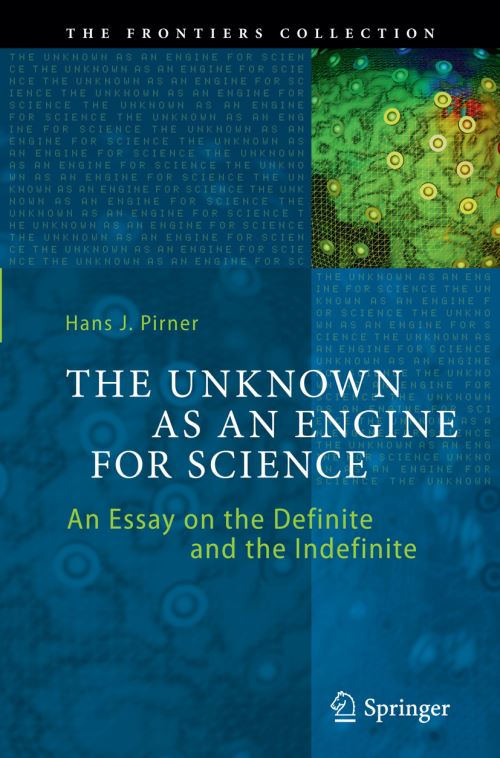
This book explores the limits of our knowledge. The author shows how uncertainty and indefiniteness not only define the borders confining our understanding, but how they feed into the process of discovery and help to push back these borders. Starting with physics the author collects examples from economics, neurophysiology, history, ecology and philosophy.
The first part shows how information helps to reduce indefiniteness. Understanding rests on our ability to find the right context, in which we localize a problem as a point in a network of connections. New elements must be combined with the old parts of the existing complex knowledge system, in order to profit maximally from the information. An attempt is made to quantify the value of information by its ability to reduce indefiniteness.
The second part explains how to handle indefiniteness with methods from fuzzy logic, decision theory, hermeneutics and semiotics. It is not sufficient that the new element appears in an experiment, one also has to find a theoretical reason for its existence. Indefiniteness becomes an engine of science, which gives rise to new ideas.
| ISBN: | 9783319386379 |
| Publication date: | 17th October 2016 |
| Author: | Hans J Pirner |
| Publisher: | Springer an imprint of Springer International Publishing |
| Format: | Paperback |
| Pagination: | 146 pages |
| Series: | The Frontiers Collection |
| Genres: |
Philosophy of science Mathematical logic Mathematical foundations Physics |
This book explores the limits of our knowledge. The author shows how uncertainty and indefiniteness not only define the borders confining our understanding, but how they feed into the process of discovery and help to push back these borders.
The Unknown as an Engine for Science features in the following genres: Philosophy of science, Mathematical logic, Mathematical foundations, Physics
Paperback. Not Available.
The Unknown as an Engine for Science was written by Hans J Pirner and published by Springer an imprint of Springer International Publishing
The Unknown as an Engine for Science has 146 pages
Yes it is part of The Frontiers Collection series