

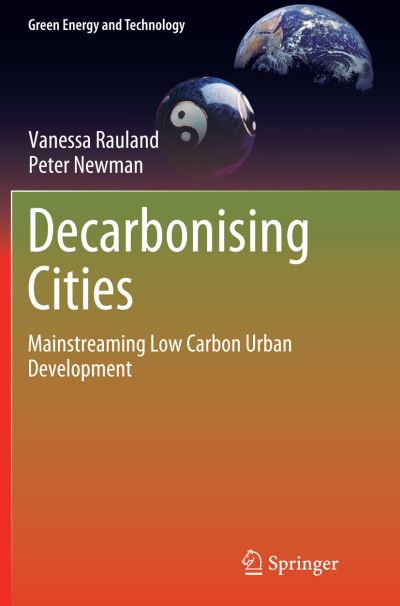
This book sets out some positive directions to move forward including government policy and regulatory options, an innovative GRID (Greening, Regenerative, Improvement Districts) scheme that can assist with funding and management, and the first steps towards an innovative carbon credit scheme for the built environment.
Decarbonising cities is a global agenda with huge significance for the future of urban civilisation. Global demonstrations have shown that technology and design issues are largely solved. However, the mainstreaming of low carbon urban development, particularly at the precinct scale, currently lacks sufficient: standards for measuring carbon covering operational, embodied and transport emissions; assessment and decision-making tools to assist in design options; certifying processes for carbon neutrality within the built environment; and accreditation processes for enabling carbon credits to be generated from precinct-wide urban development.
Numerous barriers are currently hindering greater adoption of high performance, low carbon developments, many of which relate to implementation and governance. How to enable and manage precinct-scale renewables and other low carbon technologies within an urban setting is a particular challenge.
| ISBN: | 9783319365800 |
| Publication date: | 6th October 2016 |
| Author: | Vanessa Rauland, Peter Newman |
| Publisher: | Springer an imprint of Springer International Publishing |
| Format: | Paperback |
| Pagination: | 266 pages |
| Series: | Green Energy and Technology |
| Genres: |
The environment Environmental economics Meteorology and climatology Sustainability |
This book sets out some positive directions to move forward including government policy and regulatory options, an innovative GRID (Greening, Regenerative, Improvement Districts) scheme that can assist with funding and management, and the first steps towards an innovative carbon credit scheme for the built environment.Decarbonising cities is a global agenda with huge significance for the future of urban civilisation. Global demonstrations have shown that technology and design issues are largely solved.
Decarbonising Cities features in the following genres: The environment, Environmental economics, Meteorology and climatology, Sustainability
Paperback, Hardback. Not Available.
Decarbonising Cities was written by Vanessa Rauland, Peter Newman and published by Springer an imprint of Springer International Publishing
Decarbonising Cities has 266 pages
Yes it is part of Green Energy and Technology series