

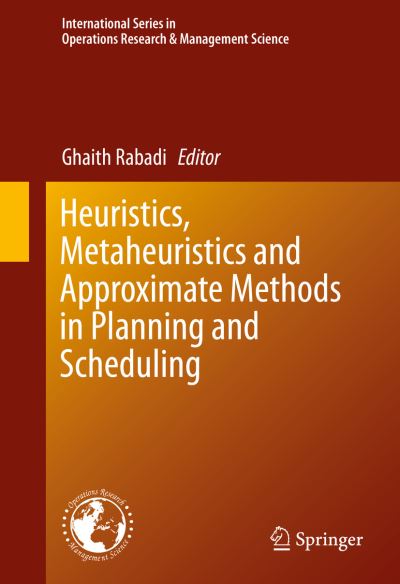
The scope of this book is limited to heuristics, metaheuristics, and approximate methods and algorithms as applied to planning and scheduling problems. While it is not possible to give a comprehensive treatment of this topic in one book, the aim of this work is to provide the reader with a diverse set of planning and scheduling problems and different heuristic approaches to solve them. The problems range from traditional single stage and parallel machine problems to more modern settings such as robotic cells and flexible job shop networks. Furthermore, some chapters deal with deterministic problems while some others treat stochastic versions of the problems. Unlike most of the literature that deals with planning and scheduling problems in the manufacturing and production environments, in this book the environments were extended to nontraditional applications such as spatial scheduling (optimizing space over time), runway scheduling, and surgical scheduling. The solution methods usedin the different chapters of the book also spread from well-established heuristics and metaheuristics such as Genetic Algorithms and Ant Colony Optimization to more recent ones such as Meta-RaPS.
| ISBN: | 9783319260228 |
| Publication date: | 4th February 2016 |
| Author: | Ghaith Rabadi |
| Publisher: | Springer an imprint of Springer International Publishing |
| Format: | Hardback |
| Pagination: | 264 pages |
| Series: | International Series in Operations Research & Management Science |
| Genres: |
Operational research Purchasing and supply management Distribution and logistics management Management decision making |
The scope of this book is limited to heuristics, metaheuristics, and approximate methods and algorithms as applied to planning and scheduling problems. While it is not possible to give a comprehensive treatment of this topic in one book, the aim of this work is to provide the reader with a diverse set of planning and scheduling problems and different heuristic approaches to solve them.
Heuristics, Metaheuristics and Approximate Methods in Planning and Scheduling features in the following genres: Operational research, Purchasing and supply management, Distribution and logistics management, Management decision making
Hardback. Not Available.
Heuristics, Metaheuristics and Approximate Methods in Planning and Scheduling was written by Ghaith Rabadi and published by Springer an imprint of Springer International Publishing
Heuristics, Metaheuristics and Approximate Methods in Planning and Scheduling has 264 pages
Yes it is part of International Series in Operations Research & Management Science series