

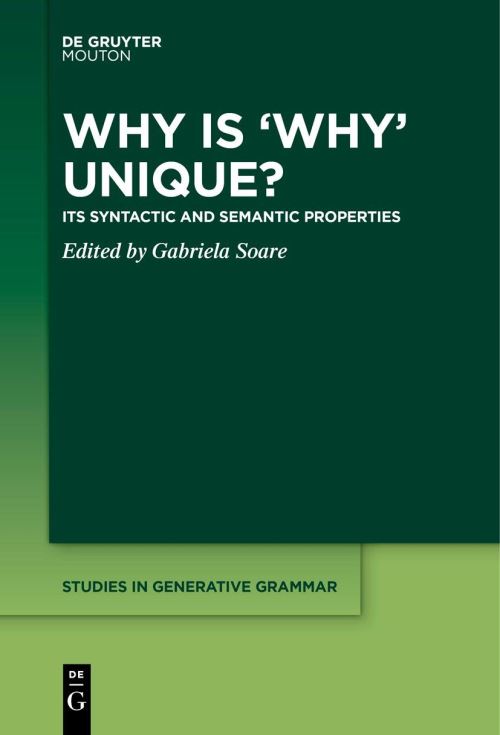
Why is 'Why' Unique? Its Syntactic and Semantic Properties considers the behaviour of this peculiar wh-element across many different languages, including Ewe, Trevisan, Italian, Basque, German, Dutch, Cantonese, Mandarin, English and Hebrew. In ten original chapters, the authors explore various aspects of why-questions, such as the way why interacts with V2 constructions in Basque, with a subject clitic in Trevisan or how its morpho-syntactic make-up determines its merge position in Ewe, to mention but a few. Furthermore, a clear-cut distinction is established between high and low reason adverbials which are subsequently examined in why-stripping environments in Dutch.
Beyond why proper, the book explores a special class of wh-expressions in some in-situ languages which give rise to unexpected why-construals with a touch of whining force. The objective is to explain the unusual syntactic position of these wh-expressions as well as their association with peculiar pragmatics.
The questions are addressed for Cantonese: are what-initial sentences genuine questions? To what extent are Cantonese what-initial sentences similar to how-initial sentences in Mandarin? Beside these what-as-why questions, a special class of rhetorical questions, the doubly-marked interrogatives in Hebrew, come under scrutiny.
Why is 'why' unique also concerns the interface with prosody and several experimental studies investigate precisely this aspect.
| ISBN: | 9783111258706 |
| Publication date: | 8th May 2023 |
| Author: | Gabriela Soare |
| Publisher: | De Gruyter Mouton |
| Format: | Paperback |
| Pagination: | 324 pages |
| Series: | Studies in Generative Grammar |
| Genres: |
Grammar, syntax and morphology Semiotics / semiology Semantics, discourse analysis, stylistics |
Why is 'Why' Unique? Its Syntactic and Semantic Properties considers the behaviour of this peculiar wh-element across many different languages, including Ewe, Trevisan, Italian, Basque, German, Dutch, Cantonese, Mandarin, English and Hebrew.
Why Is 'Why' Unique? features in the following genres: Grammar, syntax and morphology, Semiotics / semiology, Semantics, discourse analysis, stylistics
Paperback, Hardback. Not Available.
Why Is 'Why' Unique? was written by Gabriela Soare and published by De Gruyter Mouton
Why Is 'Why' Unique? has 324 pages
Yes it is part of Studies in Generative Grammar series