

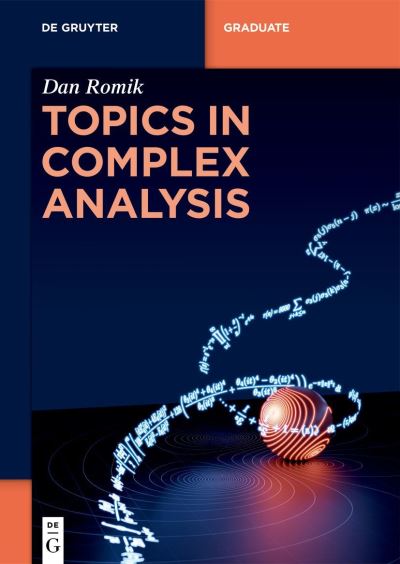
This graduate-level mathematics textbook provides an in-depth and readable exposition of selected topics in complex analysis. The material spans both the standard theory at a level suitable for a first-graduate class on the subject and several advanced topics delving deeper into the subject and applying the theory in different directions. The focus is on beautiful applications of complex analysis to geometry and number theory. The text is accompanied by beautiful figures illustrating many of the concepts and proofs.
Among the topics covered are asymptotic analysis; conformal mapping and the Riemann mapping theory; the Euler gamma function, the Riemann zeta function, and a proof of the prime number theorem; elliptic functions, and modular forms. The final chapter gives the first detailed account in textbook format of the recent solution to the sphere packing problem in dimension 8, published by Maryna Viazovska in 2016 - a groundbreaking proof for which Viazovska was awarded the Fields Medal in 2022.
The book is suitable for self-study by graduate students or advanced undergraduates with an interest in complex analysis and its applications, or for use as a textbook for graduate mathematics classes, with enough material for 2-3 semester-long classes. Researchers in complex analysis, analytic number theory, modular forms, and the theory of sphere packing, will also find much to enjoy in the text, including new material not found in standard textbooks.
| ISBN: | 9783110796780 |
| Publication date: | 21st August 2023 |
| Author: | Dan Romik |
| Publisher: | De Gruyter |
| Format: | Paperback |
| Pagination: | 308 pages |
| Series: | De Gruyter Textbook |
| Genres: |
Complex analysis, complex variables |
This graduate-level mathematics textbook provides an in-depth and readable exposition of selected topics in complex analysis. The material spans both the standard theory at a level suitable for a first-graduate class on the subject and several advanced topics delving deeper into the subject and applying the theory in different directions.
Topics in Complex Analysis features in the following genres: Complex analysis, complex variables
Paperback. £68.40, down from the £76.00 cover price. Not Available.
Topics in Complex Analysis was written by Dan Romik and published by De Gruyter
Topics in Complex Analysis has 308 pages
Yes it is part of De Gruyter Textbook series
£68.40, reduced from £76.00. Not Available.