

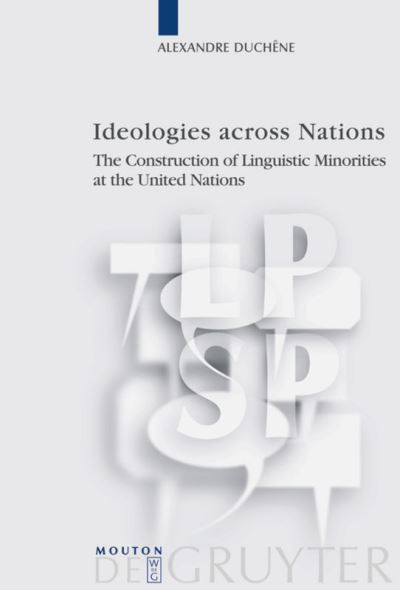
The book is an invitation to a genealogical understanding of the ideological and discursive processes that have emerged out of the regulation of linguistic minorities issues within an international context and, more precisely, at the United Nations. It highlights the contradictions, limits and possibilities in the elaboration of international measures within the universalist framework of human rights. The book also emphasizes the paradoxes between national interests and the elaboration of an international community - paradoxes in which minority issues fundamentally question the homogeneity of the state. It shows that despite the shift from national spaces to international ones, the fears of nation-states for linguistic minorities remain. Finally, the book reveals the importance of the reproduction of the interests of nation-states within an international organization and the reproduction of power through the legal management and regulation of minority rights in general, and those of linguistic minorities in particular.
Through its presentation of the history of the United Nations, its vision of the protection of linguistic minorities, the underlying ideologies that have emerged, as well as the limits and possibilities of action, the book contributes to a better understanding of the complexity of the protection of linguistic minorities and the role of language ideologies within an international context.
| ISBN: | 9783110205831 |
| Publication date: | 20th October 2008 |
| Author: | Alexandre Duchêne |
| Publisher: | De Gruyter Mouton an imprint of De Gruyter |
| Format: | Hardback |
| Pagination: | 293 pages |
| Series: | Language, Power and Social Process |
| Genres: |
Sociolinguistics International institutions Sociology |
The book is an invitation to a genealogical understanding of the ideological and discursive processes that have emerged out of the regulation of linguistic minorities issues within an international context and, more precisely, at the United Nations. It highlights the contradictions, limits and possibilities in the elaboration of international measures within the universalist framework of human rights.
Ideologies Across Nations features in the following genres: Sociolinguistics, International institutions, Sociology
Hardback. £181.80, down from the £202.00 cover price. Not Available.
Ideologies Across Nations was written by Alexandre Duchêne and published by De Gruyter Mouton an imprint of De Gruyter
Ideologies Across Nations has 293 pages
Yes it is part of Language, Power and Social Process series
£181.80, reduced from £202.00. Not Available.