

It has been argued that properties of the visual-gestural modality impose a homogenizing effect on sign languages, leading to less structural variation in sign language structure as compared to spoken language structure. However, until recently, research on sign languages was limited to a number of (Western) sign languages. Before we can truly answer the question of whether modality effects do indeed cause less structural variation, it is necessary to investigate the similarities and differences that exist between sign languages in more detail and, especially, to include in this investigation less studied sign languages.
The current research climate is testimony to a surge of interest in the study of a geographically more diverse range of sign languages. The volume reflects that climate and brings together work by scholars engaging in comparative sign linguistics research. The 11 articles discuss data from many different signed and spoken languages and cover a wide range of topics from different areas of grammar including phonology (word pictures), morphology (pronouns, negation, and auxiliaries), syntax (word order, interrogative clauses, auxiliaries, negation, and referential shift) and pragmatics (modal meaning and referential shift).
In addition to this, the contributions address psycholinguistic issues, aspects of language change, and issues concerning data collection in sign languages, thereby providing methodological guidelines for further research. Although some papers use a specific theoretical framework for analyzing the data, the volume clearly focuses on empirical and descriptive aspects of sign language variation.
| ISBN: | 9783110195781 |
| Publication date: | 20th August 2007 |
| Author: | Pamela M Perniss, Roland Pfau, Markus Steinbach |
| Publisher: | De Gruyter Mouton an imprint of De Gruyter |
| Format: | Hardback |
| Pagination: | 413 pages |
| Series: | Trends in Linguistics. Studies and Monographs [TiLSM] |
| Genres: |
Historical and comparative linguistics Sign languages, Braille and other linguistic communication |
It has been argued that properties of the visual-gestural modality impose a homogenizing effect on sign languages, leading to less structural variation in sign language structure as compared to spoken language structure. However, until recently, research on sign languages was limited to a number of (Western) sign languages.
Visible Variation features in the following genres: Historical and comparative linguistics, Sign languages, Braille and other linguistic communication
Hardback. £181.80, down from the £202.00 cover price. Not Available.
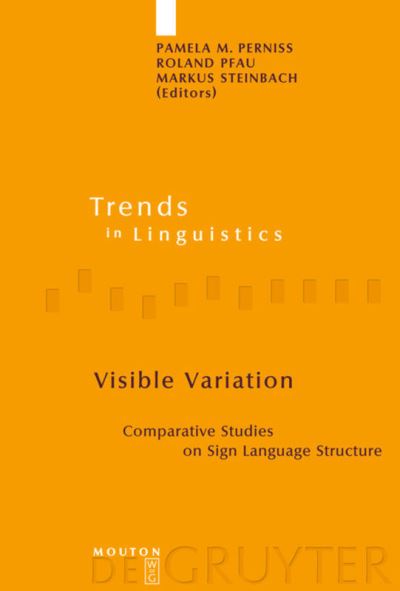
Visible Variation was written by Pamela M Perniss, Roland Pfau, Markus Steinbach and published by De Gruyter Mouton an imprint of De Gruyter
Visible Variation has 413 pages
Yes it is part of Trends in Linguistics. Studies and Monographs [TiLSM] series
£181.80, reduced from £202.00. Not Available.