

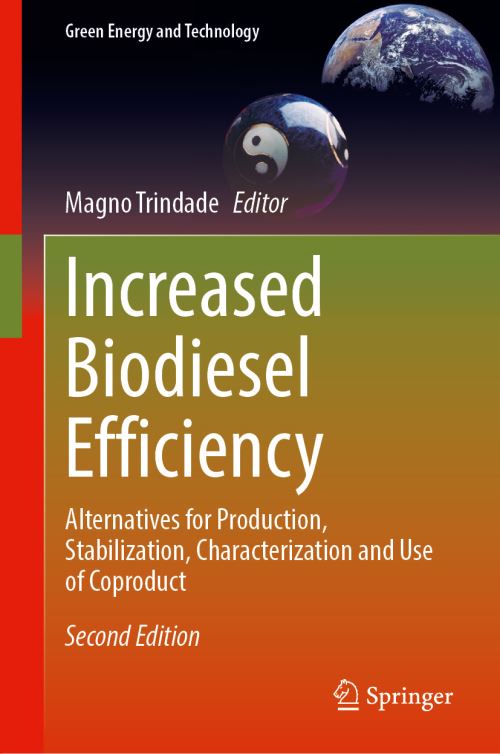
This book advances the use of biodiesel-more environmentally friendly than traditional fossil fuels-by showing how it can be synthesized at a lower cost, with greater efficiency and as a more pure and stable product. It presents methods based on fluorescence spectroscopy, which are less time-consuming than the traditional Rancimat analysis for monitoring stability, and are therefore less prone to allowing oxidative decay in the biofuel. Biodiesel exploits a variety of raw materials, from freshly harvested cottonseed to recycled cooking oil. These are cheap to produce and generate fuel lower in polluting sulfur and aromatic compounds than its petroleum-based equivalent.
Beginning by addressing different protocols for synthesis based on fatty acids, methyl and ethyl esters, it then describes chemical analyses essential to establishing the purity of the biodiesel. It highlights in detail the use of multifunctional and synthetic antioxidants, and investigates the impact of synthetic chalcones and their derivatives on the oxidative stability of biodiesel.
The author goes on to explain how to ameliorate various influences-UV irradiation and metal contaminants for example-which increase the hazards of oxidation, such as degradation and instability. New pre-treatment procedures performed using ultrasonic energies, thermostatic bath and vortex stirring are not only more environmentally friendly, but cut down on the time-consuming process of determining metal content, and allow for the use of more environmentally friendly aqueous reagents. This book investigates and demonstrates these techniques on the basis of real-world results.
Further, it suggests the practical uses of byproducts of biodiesel production, for example, using glycerol as a source of energy and high valuable chemicals. These useful techniques aid any researcher exploring the production process of biodiesel and its stabilization and characteristics.
| ISBN: | 9783032330598 |
| Publication date: | 27th November 2026 |
| Author: | Magno Trindade |
| Publisher: | Springer an imprint of Springer Nature Switzerland |
| Format: | Hardback |
| Pagination: | 348 pages |
| Series: | Green Energy and Technology |
| Genres: |
Alternative and renewable energy sources and technology Spectrum analysis, spectrochemistry, mass spectrometry Electrochemistry and magnetochemistry Sustainability Biotechnology Analytical chemistry Chemistry |
This book advances the use of biodiesel-more environmentally friendly than traditional fossil fuels-by showing how it can be synthesized at a lower cost, with greater efficiency and as a more pure and stable product. It presents methods based on fluorescence spectroscopy, which are less time-consuming than the traditional Rancimat analysis for monitoring stability, and are therefore less prone to allowing oxidative decay in the biofuel.
Increased Biodiesel Efficiency features in the following genres: Alternative and renewable energy sources and technology, Spectrum analysis, spectrochemistry, mass spectrometry, Electrochemistry and magnetochemistry, Sustainability, Biotechnology, Analytical chemistry, Chemistry
Hardback. £161.99, down from the £179.99 cover price. Not Available.
Increased Biodiesel Efficiency was written by Magno Trindade and published by Springer an imprint of Springer Nature Switzerland
Increased Biodiesel Efficiency has 348 pages
Yes it is part of Green Energy and Technology series
£161.99, reduced from £179.99. Not Available.