

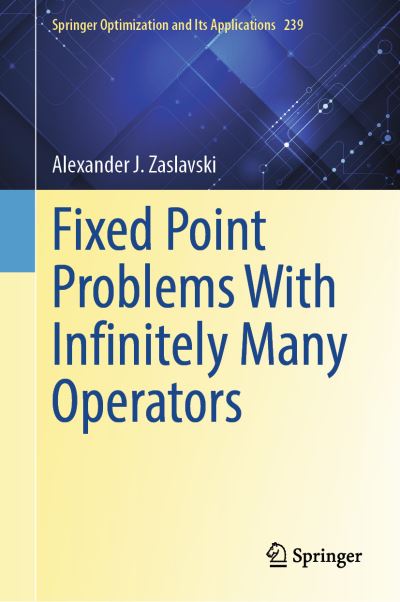
This book explores the intricate world of fixed point theory for nonlinear operators, focusing on the challenges and solutions associated with common fixed point problems in various mathematical spaces. At its core, the book addresses the construction of fixed points for nonlinear mappings, extending the classical results to more complex scenarios involving infinite families of operators.
Key concepts include the study of common fixed point problems in Hilbert, normed, and metric spaces, with particular attention to the presence of computational errors. The authors present innovative algorithms, such as the Cimmino and string-averaging algorithms, demonstrating their convergence even under practical constraints. Readers will encounter a thorough examination of iterative schemes, subgradient algorithms, and proximal point methods, all tailored to handle the complexities of infinite operator families.
This volume is an essential resource for mathematicians, researchers, and advanced students specializing in fixed point theory, optimization, and computational mathematics. By providing both theoretical insights and practical algorithms, the book equips readers with the tools needed to tackle challenging problems in abstract spaces, making it a valuable addition to any mathematical library.
| ISBN: | 9783032222442 |
| Publication date: | 26th January 2027 |
| Author: | Alexander J Zaslavski |
| Publisher: | Springer an imprint of Springer Nature Switzerland |
| Format: | Hardback |
| Pagination: | 352 pages |
| Series: | Springer Optimization and Its Applications |
| Genres: |
Functional analysis and transforms Optimization Calculus and mathematical analysis |
This book explores the intricate world of fixed point theory for nonlinear operators, focusing on the challenges and solutions associated with common fixed point problems in various mathematical spaces. At its core, the book addresses the construction of fixed points for nonlinear mappings, extending the classical results to more complex scenarios involving infinite families of operators.
Fixed Point Problems With Infinitely Many Operators features in the following genres: Functional analysis and transforms, Optimization, Calculus and mathematical analysis
Hardback. £125.99, down from the £139.99 cover price. Not Available.
Fixed Point Problems With Infinitely Many Operators was written by Alexander J Zaslavski and published by Springer an imprint of Springer Nature Switzerland
Fixed Point Problems With Infinitely Many Operators has 352 pages
Yes it is part of Springer Optimization and Its Applications series
£125.99, reduced from £139.99. Not Available.