

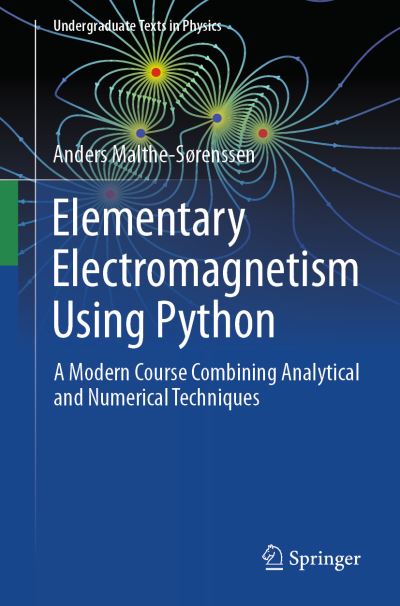
This textbook presents the core elements of an introductory electromagnetism course, integrating computational methods throughout the explanations, examples, and exercises. This approach helps students develop stronger problem?solving skills, enabling them to tackle complex and realistic physics problems earlier than would be possible using only analytical techniques. It promotes creativity, encourages exploration, and equips students with the tools to become active investigators while learning physics.
The book's philosophy is to provide worked examples that demonstrate the full workflow of solving physics problems, from modeling a system and simplifying it to an analytically solvable form to solving the complete model using computational methods. Each theoretical and computational step is clearly explained.
Key computational techniques include numerical line, surface, and volume integrals; solutions to Laplace's and Poisson's equations; and computational analyses of simple and complex circuits. Laplace's and Poisson's equations receive particular emphasis, as the computational tools developed allow students to study complex systems in depth.
By applying similar computational methods across different topics, students can identify connections within the theory and build confidence and proficiency.
The book offers clear explanations of both analytical and computational techniques and includes a wide range of exercises: discussion questions, skill?building tutorials, advanced homework problems, and extended projects that combine analytical and computational approaches in rich, contextual settings.
| ISBN: | 9783032198754 |
| Publication date: | 19th July 2026 |
| Author: | Anders MaltheSørenssen |
| Publisher: | Springer an imprint of Springer Nature Switzerland |
| Format: | Paperback |
| Pagination: | 523 pages |
| Series: | Undergraduate Texts in Physics |
| Genres: |
Mathematical physics Maths for engineers Programming and scripting languages: general Electricity, electromagnetism and magnetism |
This textbook presents the core elements of an introductory electromagnetism course, integrating computational methods throughout the explanations, examples, and exercises. This approach helps students develop stronger problem?solving skills, enabling them to tackle complex and realistic physics problems earlier than would be possible using only analytical techniques.
Elementary Electromagnetism Using Python features in the following genres: Mathematical physics, Maths for engineers, Programming and scripting languages: general, Electricity, electromagnetism and magnetism
Paperback. £58.49, down from the £64.99 cover price. Not Available.
Elementary Electromagnetism Using Python was written by Anders MaltheSørenssen and published by Springer an imprint of Springer Nature Switzerland
Elementary Electromagnetism Using Python has 523 pages
Yes it is part of Undergraduate Texts in Physics series
£58.49, reduced from £64.99. Not Available.