

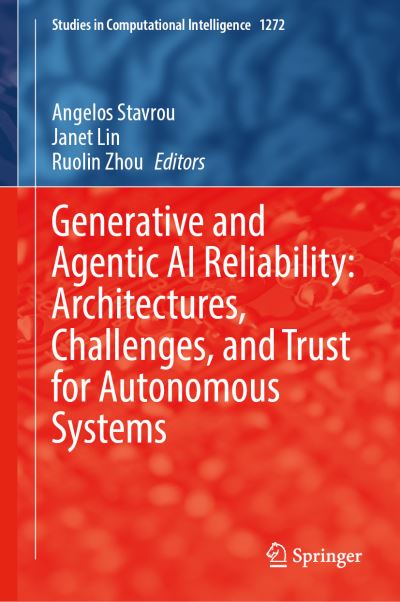
This book offers a unique and timely contribution to the intersection of agentic AI, reliability engineering, and system trustworthiness. This book addresses both sides of the reliability challenge: how to ensure the reliability of agentic AI systems (with autonomy, planning, and goal-directed behavior), and how agentic AI can be used to enhance the reliability of critical infrastructure and industrial systems (e.g., energy, transportation, manufacturing). It introduces a layered architectural framework that connects technical design (models, execution, cognition) with system-level trust and explainability. This book outlines how awareness and transparency can be engineered into each layer, supporting dependable human-AI collaboration. Beyond technical detail, the book helps researchers, practitioners, and policymakers understand both the barriers and enabling factors for adopting agentic AI in real-world reliability-critical domains. It draws on examples from sectors like power systems, autonomous transportation, and predictive maintenance. This book includes a survey and critical analysis of the current state of regulatory frameworks and standards organizations (e.g., IEEE, ISO, EU AI Act), highlighting gaps and aligning recommendations with the evolving compliance landscape. This book provides an interdisciplinary bridge between AI development, systems reliability engineering, and AI policy/ethics communities-making it relevant for a wide audience across academia, industry, and regulatory bodies.
| ISBN: | 9783032185846 |
| Publication date: | 29th August 2026 |
| Author: | Angelos Stavrou, Janet Lin, Ruolin Zhou |
| Publisher: | Springer an imprint of Springer Nature Switzerland |
| Format: | Hardback |
| Pagination: | 359 pages |
| Series: | Studies in Computational Intelligence |
| Genres: |
Artificial intelligence Human–computer interaction Electronics engineering |
This book offers a unique and timely contribution to the intersection of agentic AI, reliability engineering, and system trustworthiness. This book addresses both sides of the reliability challenge: how to ensure the reliability of agentic AI systems (with autonomy, planning, and goal-directed behavior), and how agentic AI can be used to enhance the reliability of critical infrastructure and industrial systems (e.g., energy, transportation, manufacturing).
Generative and Agentic AI Reliability features in the following genres: Artificial intelligence, Human–computer interaction, Electronics engineering
Hardback. £143.99, down from the £159.99 cover price. Not Available.
Generative and Agentic AI Reliability was written by Angelos Stavrou, Janet Lin, Ruolin Zhou and published by Springer an imprint of Springer Nature Switzerland
Generative and Agentic AI Reliability has 359 pages
Yes it is part of Studies in Computational Intelligence series
£143.99, reduced from £159.99. Not Available.