

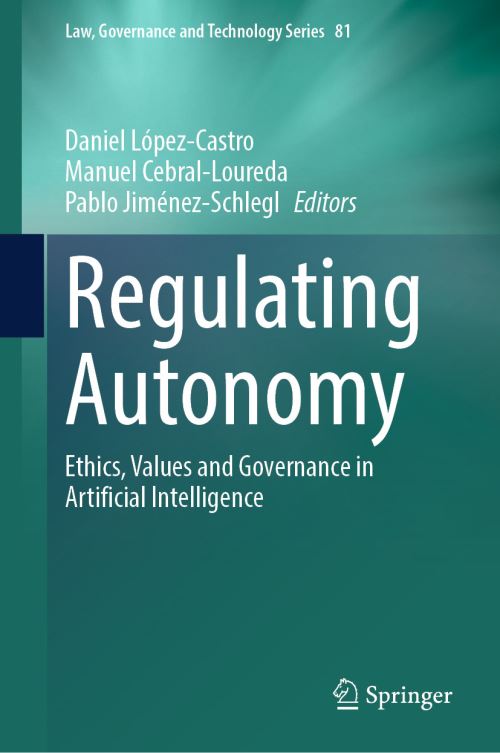
This book offers an interdisciplinary overview of autonomy in artificial intelligence and robotics, positioning it as the central concept in the contemporary debate on AI's societal integration. The term itself is dangerously ambiguous: its meaning shifts dramatically when applied to a machine versus a human. While there is consensus on machine agency (the capacity to act), attributing autonomy in the rich, normative sense we attribute it to humans is a far more controversial and complex assertion.
This volume moves beyond isolated systems to consider hybrid human-machine autonomy, a space where AI's capabilities intersect with human agency. Autonomy is therefore explored not just as a technical attribute, but as a relational concept that redefines a user's capacity for self-governance in contexts of shared decision-making, assistive technology, and human augmentation. This central tension requires a broader approach to governance. The book argues that effective "regulation" is not merely law, but a wider domain for reflection, and that technology itself is a powerful regulatory force that must be shaped by a nuanced understanding of ethics, agency, values, and law.
This book confronts this challenge through a comprehensive, four-part structure. It begins with the Ethical Dimension, examining foundational questions and the profound social and educational implications of AI. It then moves to the Agential Dimension, focusing on embodied AI, robotics, and assistive healthcare. The third section, the Axiological Dimension, interrogates the popular concept of "value alignment," moving beyond its common technical framing to advance new approaches for embedding values in hybrid systems. Finally, the Regulatory Dimension provides a practical analysis of governance, legal frameworks like the EU AI Act, and complex applications from finance to autonomous weapons.
This book will be of interest to researchers in AI, robotics, philosophy, law, and education, especially those in interdisciplinary settings. It is also essential reading for policymakers and private-sector professionals seeking to design and govern systems where the coordination of human and artificial agents is paramount.
Chapter "Repurposing Lethal Autonomous Weapons Systems for disarmament" is licensed under the terms of the Creative Commons AttributionNonCommercial-NoDerivatives 4.0 International License via Springerlink.
| ISBN: | 9783032130624 |
| Publication date: | 10th April 2026 |
| Author: | Daniel LópezCastro, Manuel CebralLoureda, Pablo JiménezSchlegl |
| Publisher: | Springer an imprint of Springer Nature Switzerland |
| Format: | Hardback |
| Pagination: | 482 pages |
| Series: | Law, Governance and Technology Series |
| Genres: |
Entertainment and media law |
This book offers an interdisciplinary overview of autonomy in artificial intelligence and robotics, positioning it as the central concept in the contemporary debate on AI's societal integration. The term itself is dangerously ambiguous: its meaning shifts dramatically when applied to a machine versus a human.
Regulating Autonomy features in the following genres: Entertainment and media law
Hardback. £134.99, down from the £149.99 cover price. Not Available.
Regulating Autonomy was written by Daniel LópezCastro, Manuel CebralLoureda, Pablo JiménezSchlegl and published by Springer an imprint of Springer Nature Switzerland
Regulating Autonomy has 482 pages
Yes it is part of Law, Governance and Technology Series series
£134.99, reduced from £149.99. Not Available.