

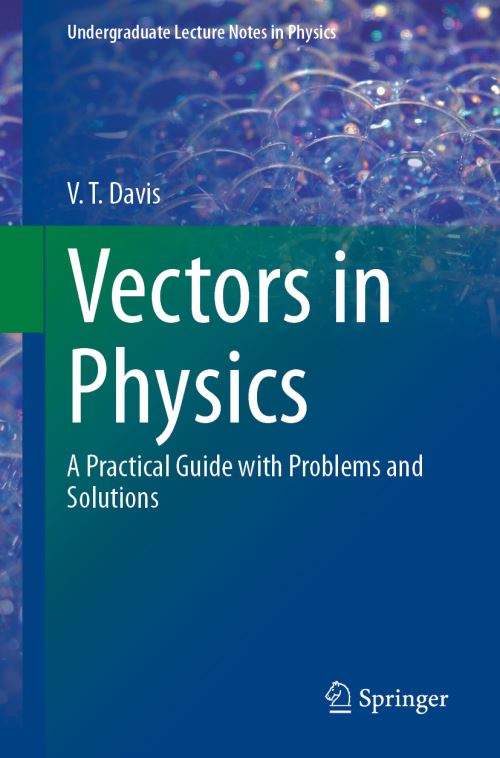
This book provides a rigorous and comprehensive exposition of vectors and vector fields, designed for advanced undergraduate students in physics. It presents detailed derivations of essential vector identities, relations involving quantum vector operators, and vector calculus theorems commonly encountered in undergraduate and graduate physics coursework. A complete catalogue of vector identities-spanning both classical and quantum contexts-is presented using index notation and the Einstein summation convention, fostering fluency with tensorial methods and streamlining complex derivations.
Core topics include vector algebra, differential and integral vector calculus, and three-dimensional Taylor expansions, supported by careful treatments of the essential underlying mathematical tools. Advanced subjects-such as the Dirac delta function, Green's functions, multipole expansions, and Cartesian tensors-are introduced with a balance of formal clarity and pedagogical accessibility.
A dedicated chapter on tensor transformations, invariants, and the Levi-Civita and Kronecker symbols offers a foundation for further study in areas such as general relativity and quantum field theory. Each chapter contains numerous worked examples and end-of-chapter problems, all accompanied by complete solutions, making the text well-suited for both structured coursework and independent study.
| ISBN: | 9783032033567 |
| Publication date: | 9th May 2026 |
| Author: | V T Davis |
| Publisher: | Springer an imprint of Springer Nature Switzerland |
| Format: | Paperback |
| Pagination: | 251 pages |
| Series: | Undergraduate Lecture Notes in Physics |
| Genres: |
Mathematical physics Algebra Particle and high-energy physics Relativity physics |
This book provides a rigorous and comprehensive exposition of vectors and vector fields, designed for advanced undergraduate students in physics. It presents detailed derivations of essential vector identities, relations involving quantum vector operators, and vector calculus theorems commonly encountered in undergraduate and graduate physics coursework.
Vectors in Physics features in the following genres: Mathematical physics, Algebra, Particle and high-energy physics, Relativity physics
Paperback. £58.49, down from the £64.99 cover price. Not Available.
Vectors in Physics was written by V T Davis and published by Springer an imprint of Springer Nature Switzerland
Vectors in Physics has 251 pages
Yes it is part of Undergraduate Lecture Notes in Physics series
£58.49, reduced from £64.99. Not Available.