

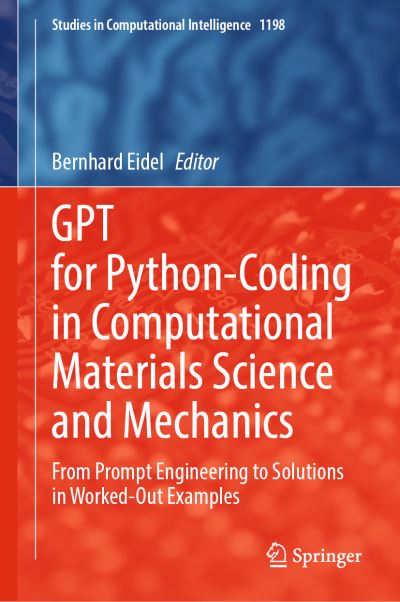
This book covers all the topics about ChatGPT required to successfully generate Python code to solve problems in computational materials science and mechanics, complemented by numerous fully worked-out applications. The complete work flow for AI-assisted coding is given, including: (i) prompt engineering providing a powerful toolset for how to give coding assignments to ChatGPT effectively; (ii) commented code listings; and (iii) tips and tricks to verify the codes in rigorous tests including human interventions to fix issues and gaps. Finally, (iv) the coding projects are critically reviewed to address the strengths and remaining weaknesses of the Chatbot, including explicit recommendations on how to communicate with GPT. For the steps (i)-(iv) the book presents a curated selection of intriguing problems from computational materials science and computational mechanics including machine learning for problem-solving. These problems are carefully chosen for their relevance to current research and industrial applications and their suitability for showcasing the advanced capabilities of GPT-4 for code generation. Spanning from predicting material behavior under various conditions to simulating complex mechanical interactions, the problems serve as a canvas on which GPT-4 paints its solutions, demonstrating not just accuracy but creativity in problem-solving. Therefore, the book serves as a valuable primer for both undergraduate and graduate students, as well as a review for research scientists and practicing engineers.
| ISBN: | 9783031854699 |
| Publication date: | 21st June 2025 |
| Author: | Bernhard Eidel |
| Publisher: | Springer an imprint of Springer Nature Switzerland |
| Format: | Hardback |
| Pagination: | 263 pages |
| Series: | Studies in Computational Intelligence |
| Genres: |
Artificial intelligence |
This book covers all the topics about ChatGPT required to successfully generate Python code to solve problems in computational materials science and mechanics, complemented by numerous fully worked-out applications. The complete work flow for AI-assisted coding is given, including: (i) prompt engineering providing a powerful toolset for how to give coding assignments to ChatGPT effectively; (ii) commented code listings; and (iii) tips and tricks to verify the codes in rigorous tests including human interventions to fix issues and gaps.
GPT for Python-Coding in Computational Materials Science and Mechanics features in the following genres: Artificial intelligence
Hardback. £143.99, down from the £159.99 cover price. Not Available.
GPT for Python-Coding in Computational Materials Science and Mechanics was written by Bernhard Eidel and published by Springer an imprint of Springer Nature Switzerland
GPT for Python-Coding in Computational Materials Science and Mechanics has 263 pages
Yes it is part of Studies in Computational Intelligence series
£143.99, reduced from £159.99. Not Available.