

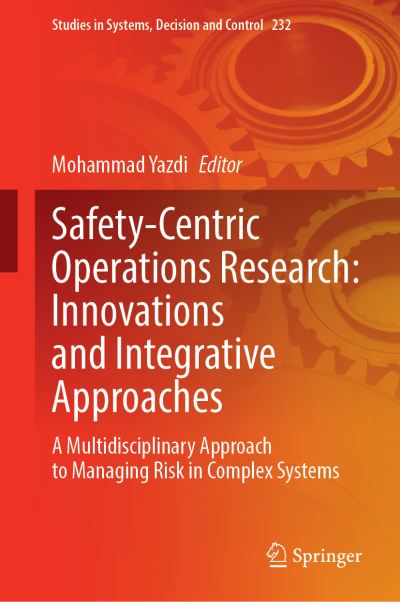
This book offers a pioneering exploration into the integration of safety considerations with operations research, providing a vital toolkit for enhancing decision-making processes in hazardous industries. It delivers comprehensive insights and innovative methodologies to foster safety-centric planning and operations across various sectors. As the complexities of modern industries increase, so does the potential for operational risks. This book addresses this challenge by merging rigorous safety analysis with the quantitative sophistication of operations research. This book aims to create safer working environments and more resilient operational frameworks. The book is divided into several key sections, each focusing on different aspects of operations research applied to safety. Initial chapters lay a theoretical foundation, discussing mathematical models and statistical methods that prioritize safety. Subsequent sections delve into specific applications within supply chain management, transportation logistics, and production planning, illustrating how these methods can be practically applied to reduce risks and enhance operational safety. Advanced topics covered include the application of machine learning and artificial intelligence to predict and mitigate potential hazards and the use of simulation techniques to model and manage operational risks. Real-world case studies are presented to show the practical implementation of these theories in industries such as manufacturing, health care, and energy, providing readers with actionable insights and proven strategies. Additionally, the book examines the cultural and behavioral aspects of safety in operations, emphasizing the importance of building a robust safety culture and integrating human factors into safety planning. Ethical and regulatory dimensions are also explored to guide practitioners in navigating the complex legal landscapes that govern safety in various industries. This book is an essential resource for students, researchers, and professionals in operations research and management, especially those involved in planning and executing operations in safety-critical sectors. It is particularly relevant for those who aim to blend technical proficiency with practical safety solutions to solve real-world challenges in operations' management.
| ISBN: | 9783031829338 |
| Publication date: | 17th February 2025 |
| Author: | Mohammad Yazdi |
| Publisher: | Springer an imprint of Springer Nature Switzerland |
| Format: | Hardback |
| Pagination: | 181 pages |
| Series: | Studies in Systems, Decision and Control |
| Genres: |
Automatic control engineering Cybernetics and systems theory Maths for engineers Electronics engineering |
This book offers a pioneering exploration into the integration of safety considerations with operations research, providing a vital toolkit for enhancing decision-making processes in hazardous industries. It delivers comprehensive insights and innovative methodologies to foster safety-centric planning and operations across various sectors.
Safety-Centric Operations Research features in the following genres: Automatic control engineering, Cybernetics and systems theory, Maths for engineers, Electronics engineering
Hardback. £143.99, down from the £159.99 cover price. Not Available.
Safety-Centric Operations Research was written by Mohammad Yazdi and published by Springer an imprint of Springer Nature Switzerland
Safety-Centric Operations Research has 181 pages
Yes it is part of Studies in Systems, Decision and Control series
£143.99, reduced from £159.99. Not Available.