

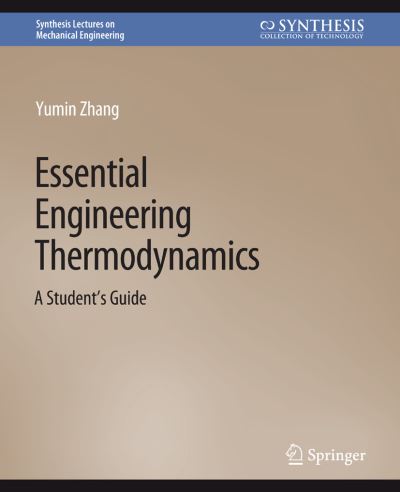
Engineering Thermodynamics is a core course for students majoring in Mechanical and Aerospace Engineering. Before taking this course, students usually have learned \textit{Engineering Mechanics}-Statics and Dynamics, and they are used to solving problems with calculus and differential equations. Unfortunately, these approaches do not apply for Thermodynamics. Instead, they have to rely on many data tables and graphs to solve problems. In addition, many concepts are hard to understand, such as entropy. Therefore, most students feel very frustrated while taking this course.
The key concept in Engineering Thermodynamics is state-properties: If one knows two properties, the state can be determined, as well as the other four properties. Unlike most textbooks, the first two chapters of this book introduce thermodynamic properties and laws with the ideal gas model, where equations can be engaged.
In this way, students can employ their familiar approaches, and thus canunderstand them much better. In order to help students understand entropy in depth, interpretation with statistical physics is introduced. Chapters 3 and 4 discuss control-mass and control-volume processes with general fluids, where the data tables are used to solve problems.
Chapter 5 covers a few advanced topics, which can also help students understand the concepts in thermodynamics from a broader perspective.
| ISBN: | 9783031796203 |
| Publication date: | 19th September 2018 |
| Author: | Yumin Zhang |
| Publisher: | Springer an imprint of Springer International Publishing |
| Format: | Paperback |
| Pagination: | 67 pages |
| Series: | Synthesis Lectures on Mechanical Engineering |
| Genres: |
Engineering: general Technical design Electrical engineering Electronics engineering |
Engineering Thermodynamics is a core course for students majoring in Mechanical and Aerospace Engineering. Before taking this course, students usually have learned \textit{Engineering Mechanics}-Statics and Dynamics, and they are used to solving problems with calculus and differential equations.
Essential Engineering Thermodynamics features in the following genres: Engineering: general, Technical design, Electrical engineering, Electronics engineering
Paperback. £22.49, down from the £24.99 cover price. Not Available.
Essential Engineering Thermodynamics was written by Yumin Zhang and published by Springer an imprint of Springer International Publishing
Essential Engineering Thermodynamics has 67 pages
Yes it is part of Synthesis Lectures on Mechanical Engineering series
£22.49, reduced from £24.99. Not Available.