

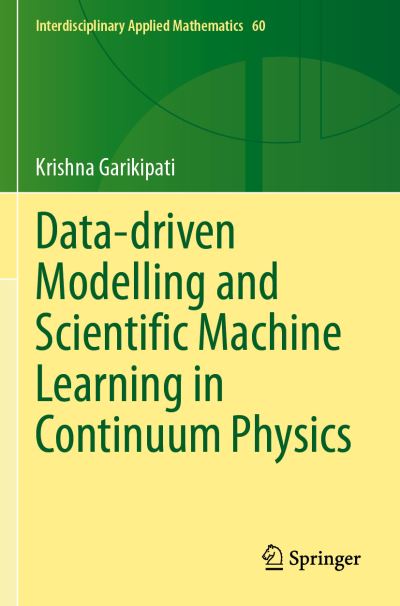
This monograph takes the reader through recent advances in data-driven methods and machine learning for problems in science-specifically in continuum physics. It develops the foundations and details a number of scientific machine learning approaches to enrich current computational models of continuum physics, or to use the data generated by these models to infer more information on these problems. The perspective presented here is drawn from recent research by the author and collaborators. Applications drawn from the physics of materials or from biophysics illustrate each topic. Some elements of the theoretical background in continuum physics that are essential to address these applications are developed first. These chapters focus on nonlinear elasticity and mass transport, with particular attention directed at descriptions of phase separation. This is followed by a brief treatment of the finite element method, since it is the most widely used approach to solve coupled partial differential equations in continuum physics.
With these foundations established, the treatment proceeds to a number of recent developments in data-driven methods and scientific machine learning in the context of the continuum physics of materials and biosystems. This part of the monograph begins by addressing numerical homogenization of microstructural response using feed-forward as well as convolutional neural networks.
Next is surrogate optimization using multifidelity learning for problems of phase evolution. Graph theory bears many equivalences to partial differential equations in its properties of representation and avenues for analysis as well as reduced-order descriptions--all ideas that offer fruitful opportunities for exploration.
Neural networks, by their capacity for representation of high-dimensional functions, are powerful for scale bridging in physics--an idea on which we present a particular perspective in the context of alloys.
One of the most compelling ideas in scientific machine learning is the identification of governing equations from dynamical data--another topic that we explore from the viewpoint of partial differential equations encoding mechanisms. This is followed by an examination of approaches to replace traditional, discretization-based solvers of partial differential equations with deterministic and probabilistic neural networks that generalize across boundary value problems. The monograph closes with a brief outlook on current emerging ideas in scientific machine learning.
| ISBN: | 9783031633645 |
| Publication date: | 31st July 2025 |
| Author: | Krishna Garikipati |
| Publisher: | Springer an imprint of Springer International Publishing |
| Format: | Paperback |
| Pagination: | 230 pages |
| Series: | Interdisciplinary Applied Mathematics |
| Genres: |
Mathematical modelling Machine learning Maths for engineers Databases |
This monograph takes the reader through recent advances in data-driven methods and machine learning for problems in science-specifically in continuum physics. It develops the foundations and details a number of scientific machine learning approaches to enrich current computational models of continuum physics, or to use the data generated by these models to infer more information on these problems.
Data-Driven Modelling and Scientific Machine Learning in Continuum Physics features in the following genres: Mathematical modelling, Machine learning, Maths for engineers, Databases
Paperback, Hardback. £98.99, down from the £109.99 cover price. Not Available.
Data-Driven Modelling and Scientific Machine Learning in Continuum Physics was written by Krishna Garikipati and published by Springer an imprint of Springer International Publishing
Data-Driven Modelling and Scientific Machine Learning in Continuum Physics has 230 pages
Yes it is part of Interdisciplinary Applied Mathematics series
£98.99, reduced from £109.99. Not Available.