

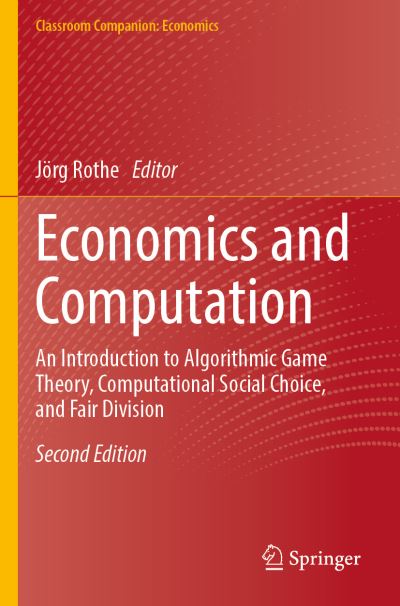
This textbook connects three vibrant areas at the interface between economics and computer science: algorithmic game theory, computational social choice, and fair division. It thus offers an interdisciplinary treatment of collective decision making from an economic and computational perspective. Part I introduces to algorithmic game theory, focusing on both noncooperative and cooperative game theory. Part II introduces to computational social choice, focusing on both preference aggregation (voting) and judgment aggregation. Part III introduces to fair division, focusing on the division of both a single divisible resource ("cake-cutting") and multiple indivisible and unshareable resources ("multiagent resource allocation"). In all these parts, much weight is given to the algorithmic and complexity-theoretic aspects of problems arising in these areas, and the interconnections between the three parts are of central interest.
| ISBN: | 9783031601019 |
| Publication date: | 29th June 2025 |
| Author: | Jörg Rothe |
| Publisher: | Springer an imprint of Springer Nature Switzerland |
| Format: | Paperback |
| Pagination: | 766 pages |
| Series: | Classroom Companion: Economics |
| Genres: |
Economic theory and philosophy Cybernetics and systems theory Microeconomics Political economy Philosophy of mathematics Mathematical theory of computation |
This textbook connects three vibrant areas at the interface between economics and computer science: algorithmic game theory, computational social choice, and fair division. It thus offers an interdisciplinary treatment of collective decision making from an economic and computational perspective.
Economics and Computation features in the following genres: Economic theory and philosophy, Cybernetics and systems theory, Microeconomics, Political economy, Philosophy of mathematics, Mathematical theory of computation
Paperback. £80.99, down from the £89.99 cover price. Not Available.
Economics and Computation was written by Jörg Rothe and published by Springer an imprint of Springer Nature Switzerland
Economics and Computation has 766 pages
Yes it is part of Classroom Companion: Economics series
£80.99, reduced from £89.99. Not Available.