

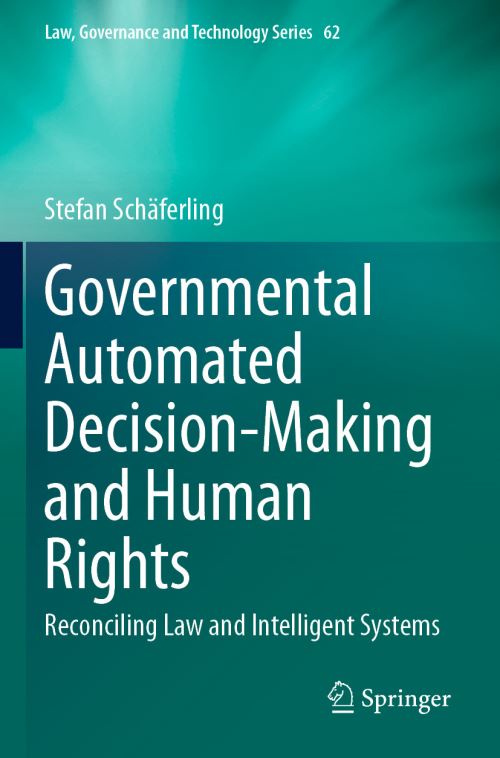
With the growing capabilities of artificial intelligence, governments are integrating AI technologies into administrative and even judicial decision-making, aiding and in some cases even replacing human decision-makers. Predictive policing, automated benefits administration, and automated risk assessment in criminal sentencing are but a few prominent examples of a general trend. While the turn towards governmental automated decision-making promises to reduce the impact of human biases and produce efficiency gains, reducing the human element in governmental decision-making also entails significant risks.
This book analyses these risks through a comparative constitutional law and human rights lens, examining US law, German law, and international human rights law. It also highlights the structural challenges that automation poses for legal systems built on the assumption of exclusively human decision-making. Special attention is paid to the question whether existing law can adequately address the lack of transparency in governmental automated decision-making, its discriminatory processes and outcomes, as well as its fundamental challenge to human agency.
Building on that analysis, it proposes a path towards securing the values of human dignity and agency at the heart of democratic societies and the rule of law in an increasingly automated world. This book will be of interest to researchers and scholars focusing on the evolving relationship of law and technology as well as human rights scholars. Further, it represents a valuable contribution to the debate on the regulation of artificial intelligence and the role human rights can play in that process.
| ISBN: | 9783031481277 |
| Publication date: | 8th December 2024 |
| Author: | Stefan Schäferling |
| Publisher: | Springer an imprint of Springer Nature Switzerland |
| Format: | Paperback |
| Pagination: | 305 pages |
| Series: | Law, Governance and Technology Series |
| Genres: |
Entertainment and media law Human rights, civil rights Artificial intelligence |
With the growing capabilities of artificial intelligence, governments are integrating AI technologies into administrative and even judicial decision-making, aiding and in some cases even replacing human decision-makers. Predictive policing, automated benefits administration, and automated risk assessment in criminal sentencing are but a few prominent examples of a general trend.
Governmental Automated Decision-Making and Human Rights features in the following genres: Entertainment and media law, Human rights, civil rights, Artificial intelligence
Paperback. £125.99, down from the £139.99 cover price. Not Available.
Governmental Automated Decision-Making and Human Rights was written by Stefan Schäferling and published by Springer an imprint of Springer Nature Switzerland
Governmental Automated Decision-Making and Human Rights has 305 pages
Yes it is part of Law, Governance and Technology Series series
£125.99, reduced from £139.99. Not Available.