

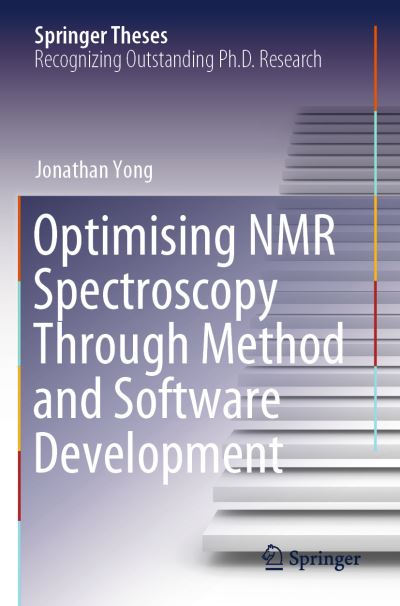
This book provides a comprehensive overview of Nuclear Magnetic Resonance (NMR) theory, its applications, and advanced techniques to improve the quality and speed of NMR data acquisition. In this book, the author expands his outstanding Ph.D. thesis and provides a valuable resource for researchers, professionals, and students in the field of NMR spectroscopy.
The book covers quantum mechanics basics, and topics like density operators, pulse sequences, 1D pulse acquisition, INEPT (Insensitive nuclei enhancement by polarization transfer), product operators, and 2D NMR principles. It also explores innovative experiments like States HSQC (Heteronuclear Single Quantum Coherence) and echo-antiecho HSQC with gradients.
In the subsequent chapters, the author discusses Pure Shift NMR, including PSYCHE (Pure Shift Yielded by Chirp Excitation) and its optimizations, such as waveform parameterization and time-reversal methods. The 'Discrete PSYCHE' approach and Ultrafast PSYCHE-iDOSY (Diffusion-ordered spectroscopy) are also highlighted.
This book presents the POISE (Parameter Optimisation by Iterative Spectral Evaluation) software for real-time NMR experiment optimization, including pulse width calibration and Ernst angle optimization, and demonstrates applications across various NMR experiments.
Lastly, the book examines accelerated 2D NMR data collection and the NOAH (NMR by Ordered Acquisition using 1H detection) supersequences, emphasizing automated pulse program creation using GENESIS (GENEration of Supersequences In Silico). Covered NMR experiments include 13C sensitivity-enhanced HSQC, 15N HMQC (Heteronuclear Multiple Quantum Coherence), dual HSQC, HSQC-TOCSY (Total Correlation Spectroscopy), HMBC (Heteronuclear Multiple Bond Correlation), and ADEQUATE (Adequate Sensitivity Double-Quantum Spectroscopy).
| ISBN: | 9783031466861 |
| Publication date: | 10th January 2025 |
| Author: | Jonathan Yong |
| Publisher: | Springer an imprint of Springer Nature Switzerland |
| Format: | Paperback |
| Pagination: | 282 pages |
| Series: | Springer Theses |
| Genres: |
Spectrum analysis, spectrochemistry, mass spectrometry Quantum and theoretical chemistry Engineering applications of electronic, magnetic, optical materials Software Engineering Physical chemistry Analytical chemistry |
This book provides a comprehensive overview of Nuclear Magnetic Resonance (NMR) theory, its applications, and advanced techniques to improve the quality and speed of NMR data acquisition. In this book, the author expands his outstanding Ph.D. thesis and provides a valuable resource for researchers, professionals, and students in the field of NMR spectroscopy.
Optimising NMR Spectroscopy Through Method and Software Development features in the following genres: Spectrum analysis, spectrochemistry, mass spectrometry, Quantum and theoretical chemistry, Engineering applications of electronic, magnetic, optical materials, Software Engineering, Physical chemistry, Analytical chemistry
Paperback, Hardback. £179.99, down from the £199.99 cover price. Not Available.
Optimising NMR Spectroscopy Through Method and Software Development was written by Jonathan Yong and published by Springer an imprint of Springer Nature Switzerland
Optimising NMR Spectroscopy Through Method and Software Development has 282 pages
Yes it is part of Springer Theses series
£179.99, reduced from £199.99. Not Available.