

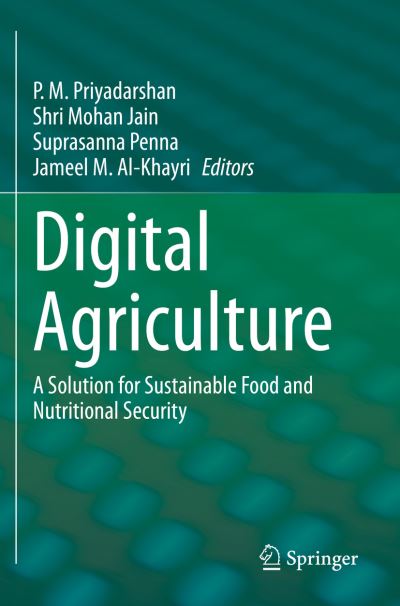
The world population is increasing while arable land is decreasing at an alarming rate. About one-quarter of arable land is degraded and needs significant restoration before it can sustain crops again. By 2030, the water supply will fall 40% short of meeting global demand. Moreover, looming climate change poses additional challenge to increasing food production to feed 10 billion people by 2050. Current major agricultural systems are on a largely unsustainable trajectory because of their contributions to greenhouse gas emissions, water pollution, and biodiversity loss.
For these reasons, innovative technologies are being introduced in modern agriculture to sustain food production. They include digital and geospatial technologies to manage soil, climate and plant genetic resources. With the development of tools and sensors integrated into the internet of things (IoT) environment, physically collected information is converted into computer-readable language. Digital innovations thus allow real-time analysis, machine learning, and artificial intelligence (AI) that manage massive amount of data, also known as big data. Accordingly, digital agriculture affords greater potential for sustainable farming and economic benefits.
This book summarizes the latest advances in AI-integration of agriculture practices. Specific focus includes but not limited to, big data, yield mapping, pests management, and optimal fertigation. As such, it presents a forward-looking approach to meet multiple UN Sustainable Development Goals, specifically, SDG 2, 6, 13 and 15.
| ISBN: | 9783031435508 |
| Publication date: | 26th January 2025 |
| Author: | P M Priyadarshan, Shri Mohan Jain, Suprasanna Penna, Jameel M AlKhayri |
| Publisher: | Springer an imprint of Springer International Publishing |
| Format: | Paperback |
| Pagination: | 643 pages |
| Genres: |
Agricultural science Food security and supply Biotechnology Botany and plant sciences Applied computing |
The world population is increasing while arable land is decreasing at an alarming rate. About one-quarter of arable land is degraded and needs significant restoration before it can sustain crops again. By 2030, the water supply will fall 40% short of meeting global demand. Moreover, looming climate change poses additional challenge to increasing food production to feed 10 billion people by 2050. Current major agricultural systems are on a largely unsustainable trajectory because of their contributions to greenhouse gas emissions, water pollution, and biodiversity loss.
For these reasons, innovative technologies are being introduced in modern agriculture to sustain food production. They include digital and geospatial technologies to manage soil, climate and plant genetic resources. With the development of tools and sensors integrated into the internet of things (IoT) environment, physically collected information is converted into computer-readable language. Digital innovations thus allow real-time analysis, machine learning, and artificial intelligence (AI) that manage massive amount of data, also known as big data. Accordingly, digital agriculture affords greater potential for sustainable farming and economic benefits.
This book summarizes the latest advances in AI-integration of agriculture practices. Specific focus includes but not limited to, big data, yield mapping, pests management, and optimal fertigation. As such, it presents a forward-looking approach to meet multiple UN Sustainable Development Goals, specifically, SDG 2, 6, 13 and 15.
Digital Agriculture features in the following genres: Agricultural science, Food security and supply, Biotechnology, Botany and plant sciences, Applied computing
Digital Agriculture is available in Paperback
Digital Agriculture was written by P M Priyadarshan, Shri Mohan Jain, Suprasanna Penna, Jameel M AlKhayri and published by Springer an imprint of Springer International Publishing
Digital Agriculture has 643 pages
£179.99