

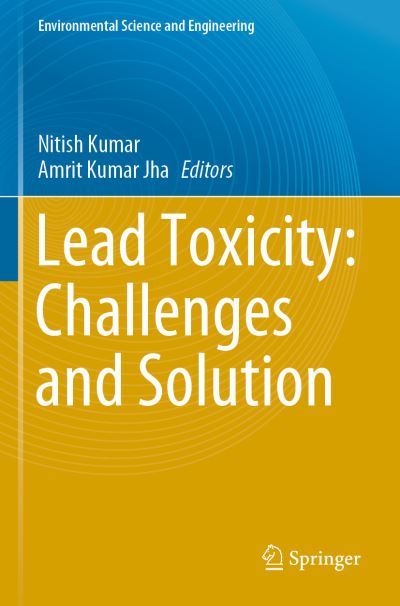
This book delivers an outline to graduate, undergraduate students, and researchers, as well as academicians who are working on lead toxicity with respect to remediation. It covers sources of lead contamination and its impact on human health and on prospective remediation through multi-disciplinary approaches with application of recent advanced biological technology. Lead is among the elements that have been most extensively used by man over time.
This has led to extensive pollution of surface soils on the local scale, mainly associated with mining and smelting of the metal and addition of organic lead compounds to petrol. Release of lead to the atmosphere from various high-temperature processes has led to surface contamination on the regional and even global scale. In addition, plants grown on lead-rich soils incorporate lead, and thus, the concentration of lead in crop plants may be increased.
Lead enters in the food chain through consumption of plant material. A high concentration oflead has been found to be harmful to vegetation. As the lead concentration increases, it adversely affects several biological parameters and eventually renders the soil barren.
This edited book brings together a diverse group of researchers to address the challenges posed by global mass poisoning caused by lead contamination of soil and plants. The book sheds light on this global environmental issue and proposes solutions to contamination through multi-disciplinary approaches. This book contains three sections.
The first section describes the different sources and distribution of lead in soil and plant ecosystems. The second section explains the health risks linked to lead toxicity. The third section addresses sustainable lead toxicity mitigation strategies and the potential applications of recent biological technology in providing solutions.
This book is a valuable resource to students, academics, researchers, and environmental professionals doing fieldwork on lead contamination throughout the world.
| ISBN: | 9783031373299 |
| Publication date: | 10th August 2024 |
| Author: | Nitish Kumar, Amrit Kumar Jha |
| Publisher: | Springer an imprint of Springer Nature Switzerland |
| Format: | Paperback |
| Pagination: | 308 pages |
| Series: | Environmental Science and Engineering |
| Genres: |
Environmental factors Ecological science, the Biosphere Microbiology (non-medical) Pollution and threats to the environment Biotechnology Agricultural science Environmental chemistry |
This book delivers an outline to graduate, undergraduate students, and researchers, as well as academicians who are working on lead toxicity with respect to remediation. It covers sources of lead contamination and its impact on human health and on prospective remediation through multi-disciplinary approaches with application of recent advanced biological technology.
Lead Toxicity features in the following genres: Environmental factors, Ecological science, the Biosphere, Microbiology (non-medical), Pollution and threats to the environment, Biotechnology, Agricultural science, Environmental chemistry
Paperback. £161.99, down from the £179.99 cover price. Not Available.
Lead Toxicity was written by Nitish Kumar, Amrit Kumar Jha and published by Springer an imprint of Springer Nature Switzerland
Lead Toxicity has 308 pages
Yes it is part of Environmental Science and Engineering series
£161.99, reduced from £179.99. Not Available.