

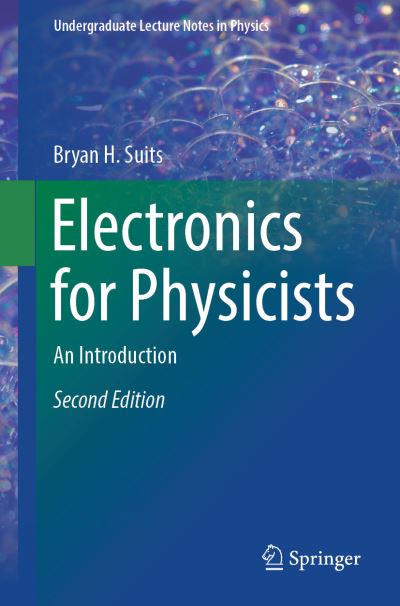
This book provides undergraduate physics majors and students of related sciences with a sound understanding of basic electronics and how it is used in the physical sciences. While today few science students go on to careers that demand an ability to design and build electronic circuits, many will use and rely on electronics.
As scientists, they will require an appropriate level of fundamental knowledge that enables them, for example, to understand what electronic equipment is doing, to correctly interpret the measurements obtained, and to appreciate the numerous links between electronics and how it is practiced and other areas of science.
Discussing electronics in the broader context and from the point of view of the scientist, this book is intended for students who are not planning to become electronics specialists but who will use electronics. It has been written in a relatively informal style and includes many detailed examples, as well assome "outside the box" material, including some ideas from quantum computing, to inspire thought and creativity. A selection of relevant exercises is included at the end of each chapter.
In the updated second edition, some sections are clarified and end-of-chapter problems are added. It includes an additional chapter on quantum logic/computing
| ISBN: | 9783031363634 |
| Publication date: | 30th August 2023 |
| Author: | Bryan H Suits |
| Publisher: | Springer an imprint of Springer International Publishing |
| Format: | Paperback |
| Pagination: | 404 pages |
| Series: | Undergraduate Lecture Notes in Physics |
| Genres: |
Electronics: circuits and components Mathematical theory of computation Scientific standards, measurement etc Quantum physics (quantum mechanics and quantum field theory) Physical chemistry |
This book provides undergraduate physics majors and students of related sciences with a sound understanding of basic electronics and how it is used in the physical sciences. While today few science students go on to careers that demand an ability to design and build electronic circuits, many will use and rely on electronics.
Electronics for Physicists features in the following genres: Electronics: circuits and components, Mathematical theory of computation, Scientific standards, measurement etc, Quantum physics (quantum mechanics and quantum field theory), Physical chemistry
Paperback. £53.99, down from the £59.99 cover price. Not Available.
Electronics for Physicists was written by Bryan H Suits and published by Springer an imprint of Springer International Publishing
Electronics for Physicists has 404 pages
Yes it is part of Undergraduate Lecture Notes in Physics series
£53.99, reduced from £59.99. Not Available.