

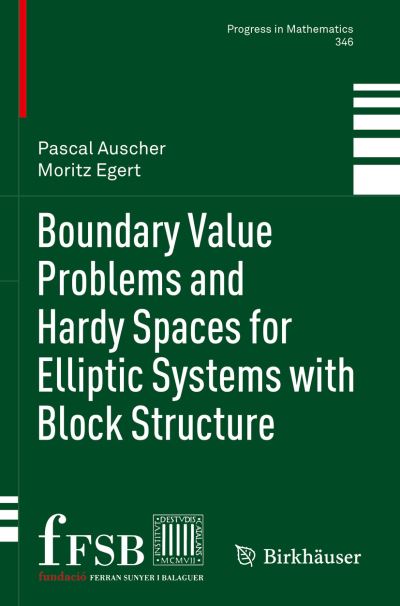
In this monograph, for elliptic systems with block structure in the upper half-space and t-independent coefficients, the authors settle the study of boundary value problems by proving compatible well-posedness of Dirichlet, regularity and Neumann problems in optimal ranges of exponents. Prior to this work, only the two-dimensional situation was fully understood. In higher dimensions, partial results for existence in smaller ranges of exponents and for a subclass of such systems had been established. The presented uniqueness results are completely new, and the authors also elucidate optimal ranges for problems with fractional regularity data.
The first part of the monograph, which can be read independently, provides optimal ranges of exponents for functional calculus and adapted Hardy spaces for the associated boundary operator. Methods use and improve, with new results, all the machinery developed over the last two decades to study such problems: the Kato square root estimates and Riesz transforms, Hardy spaces associated to operators, off-diagonal estimates, non-tangential estimates and square functions, and abstract layer potentials to replace fundamental solutions in the absence of local regularity of solutions.| ISBN: | 9783031299759 |
| Publication date: | 28th July 2024 |
| Author: | Pascal Auscher, Moritz Egert |
| Publisher: | Birkhauser an imprint of Springer International Publishing |
| Format: | Paperback |
| Pagination: | 310 pages |
| Series: | Progress in Mathematics |
| Genres: |
Differential calculus and equations Complex analysis, complex variables Functional analysis and transforms |
In this monograph, for elliptic systems with block structure in the upper half-space and t-independent coefficients, the authors settle the study of boundary value problems by proving compatible well-posedness of Dirichlet, regularity and Neumann problems in optimal ranges of exponents. Prior to this work, only the two-dimensional situation was fully understood. In higher dimensions, partial results for existence in smaller ranges of exponents and for a subclass of such systems had been established. The presented uniqueness results are completely new, and the authors also elucidate optimal ranges for problems with fractional regularity data.
Boundary Value Problems and Hardy Spaces for Elliptic Systems With Block Structure features in the following genres: Differential calculus and equations, Complex analysis, complex variables, Functional analysis and transforms
Paperback. £98.99, down from the £109.99 cover price. Not Available.
Boundary Value Problems and Hardy Spaces for Elliptic Systems With Block Structure was written by Pascal Auscher, Moritz Egert and published by Birkhauser an imprint of Springer International Publishing
Boundary Value Problems and Hardy Spaces for Elliptic Systems With Block Structure has 310 pages
Yes it is part of Progress in Mathematics series
£98.99, reduced from £109.99. Not Available.