

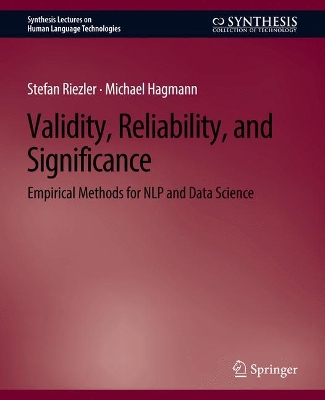
Empirical methods are means to answering methodological questions of empirical sciences by statistical techniques. The methodological questions addressed in this book include the problems of validity, reliability, and significance. In the case of machine learning, these correspond to the questions of whether a model predicts what it purports to predict, whether a model's performance is consistent across replications, and whether a performance difference between two models is due to chance, respectively.
The goal of this book is to answer these questions by concrete statistical tests that can be applied to assess validity, reliability, and significance of data annotation and machine learning prediction in the fields of NLP and data science. Our focus is on model-based empirical methods where data annotations and model predictions are treated as training data for interpretable probabilistic models from the well-understood families of generalized additive models (GAMs) and linear mixed effects models (LMEMs).
Based on the interpretable parameters of the trained GAMs or LMEMs, the book presents model-based statistical tests such as a validity test that allows detecting circular features that circumvent learning. Furthermore, the book discusses a reliability coefficient using variance decomposition based on random effect parameters of LMEMs. Last, a significance test based on the likelihood ratio of nested LMEMs trained on the performance scores of two machine learning models is shown to naturally allow the inclusion of variations in meta-parameter settings into hypothesis testing, and further facilitates a refined system comparison conditional on properties of input data.
This book can be used as an introduction to empirical methods for machine learning in general, with a special focus on applications in NLP and data science. The book is self-contained, with an appendix on the mathematical background on GAMs and LMEMs, and with an accompanying webpage including R code to replicate experiments presented in the book.
| ISBN: | 9783031010552 |
| Publication date: | 3rd December 2021 |
| Author: | Stefan Riezler, Michael Hagmann |
| Publisher: | Springer International Publishing AG |
| Format: | Paperback |
| Pagination: | 147 pages |
| Series: | Synthesis Lectures on Human Language Technologies |
| Genres: |
Artificial intelligence Natural language and machine translation Computational and corpus linguistics |
Empirical methods are means to answering methodological questions of empirical sciences by statistical techniques. The methodological questions addressed in this book include the problems of validity, reliability, and significance.
Validity, Reliability, and Significance features in the following genres: Artificial intelligence, Natural language and machine translation, Computational and corpus linguistics
Hardback, Paperback. Not Available.
Validity, Reliability, and Significance was written by Stefan Riezler, Michael Hagmann and published by Springer International Publishing AG
Validity, Reliability, and Significance has 147 pages
Yes it is part of Synthesis Lectures on Human Language Technologies series