

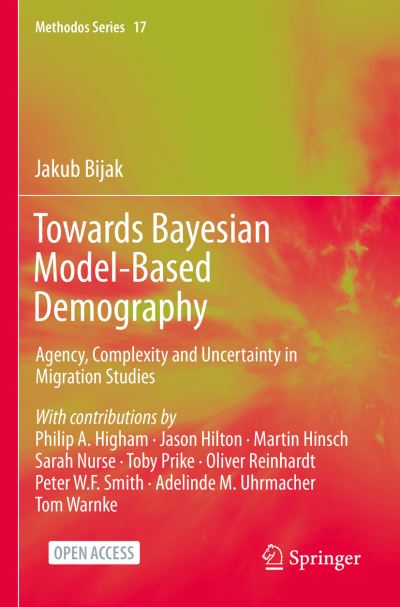
This open access book presents a ground-breaking approach to developing micro-foundations for demography and migration studies. It offers a unique and novel methodology for creating empirically grounded agent-based models of international migration - one of the most uncertain population processes and a top-priority policy area. The book discusses in detail the process of building a simulation model of migration, based on a population of intelligent, cognitive agents, their networks and institutions, all interacting with one another. The proposed model-based approach integrates behavioural and social theory with formal modelling, by embedding the interdisciplinary modelling process within a wider inductive framework based on the Bayesian statistical reasoning. Principles of uncertainty quantification are used to devise innovative computer-based simulations, and to learn about modelling the simulated individuals and the way they make decisions. The identified knowledge gaps are subsequently filled with information from dedicated laboratory experiments on cognitive aspects of human decision-making under uncertainty. In this way, the models are built iteratively, from the bottom up, filling an important epistemological gap in migration studies, and social sciences more broadly.
| ISBN: | 9783030830410 |
| Publication date: | 10th December 2021 |
| Author: | Jakub Bijak |
| Publisher: | Springer an imprint of Springer International Publishing |
| Format: | Paperback |
| Pagination: | 263 pages |
| Series: | Methodos Series |
| Genres: |
Population and demography Population and migration geography Migration, immigration and emigration Social research and statistics |
This open access book presents a ground-breaking approach to developing micro-foundations for demography and migration studies. It offers a unique and novel methodology for creating empirically grounded agent-based models of international migration - one of the most uncertain population processes and a top-priority policy area.
Towards Bayesian Model-Based Demography features in the following genres: Population and demography, Population and migration geography, Migration, immigration and emigration, Social research and statistics
Paperback. Not Available.
Towards Bayesian Model-Based Demography was written by Jakub Bijak and published by Springer an imprint of Springer International Publishing
Towards Bayesian Model-Based Demography has 263 pages
Yes it is part of Methodos Series series