

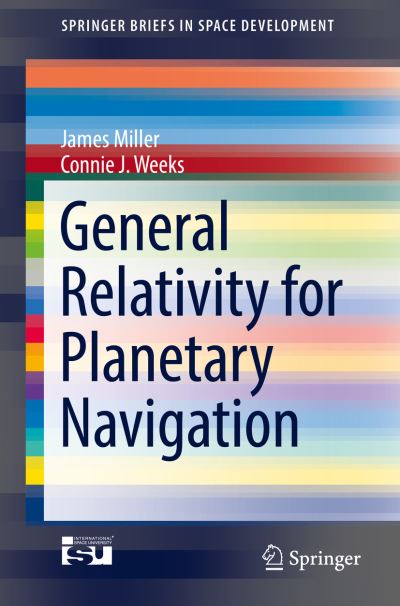
This brief approaches General Relativity from a planetary navigation perspective, delving into the unconventional mathematical methods required to produce computer software for space missions. It provides a derivation of the Einstein field equations and describes experiments performed on the Near Earth Asteroid Rendezvous mission, spanning General Relativity Theory from the fundamental assumptions to experimental verification.
The software used for planetary missions is derived from mathematics that use matrix notation. An alternative is to use Einstein summation notation, which enables the mathematics to be presented in a compact form but makes the geometry difficult to understand. In this book, the relationship of matrix notation to summation notation is shown. The purpose is to enable the reader to derive the mathematics used in the software in either matrix notation or summation notation.| ISBN: | 9783030775452 |
| Publication date: | 1st September 2021 |
| Author: | James Miller, Connie J Weeks |
| Publisher: | Springer an imprint of Springer International Publishing |
| Format: | Paperback |
| Pagination: | 104 pages |
| Series: | SpringerBriefs in Space Development |
| Genres: |
Space science Astronautics Relativity physics Aerospace and aviation technology |
This brief approaches General Relativity from a planetary navigation perspective, delving into the unconventional mathematical methods required to produce computer software for space missions. It provides a derivation of the Einstein field equations and describes experiments performed on the Near Earth Asteroid Rendezvous mission, spanning General Relativity Theory from the fundamental assumptions to experimental verification.The software used for planetary missions is derived from mathematics that use matrix notation. An alternative is to use Einstein summation notation, which enables the mathematics to be presented in a compact form but makes the geometry difficult to understand. In this book, the relationship of matrix notation to summation notation is shown. The purpose is to enable the reader to derive the mathematics used in the software in either matrix notation or summation notation. This brief is a useful tool for advanced students andyoung professionals embarking on careers in planetary navigation.
General Relativity for Planetary Navigation features in the following genres: Space science, Astronautics, Relativity physics, Aerospace and aviation technology
Paperback, Ebook. £49.49, down from the £54.99 cover price. Not Available.
General Relativity for Planetary Navigation was written by James Miller, Connie J Weeks and published by Springer an imprint of Springer International Publishing
General Relativity for Planetary Navigation has 104 pages
Yes it is part of SpringerBriefs in Space Development series
£49.49, reduced from £54.99. Not Available.