

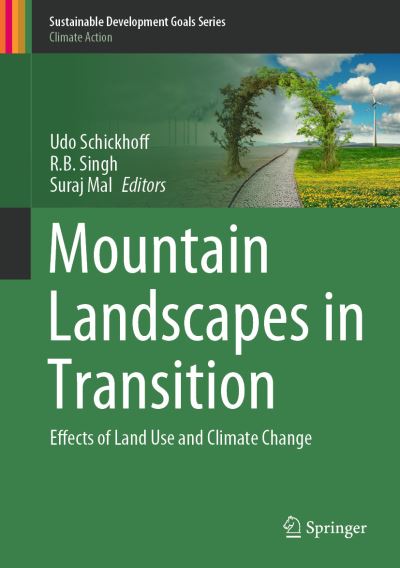
This book compiles available knowledge of the response of mountain ecosystems to recent climate and land use change and intends to bridge the gap between science, policy and the community concerned.
The chapters present key concepts, major drivers and key processes of mountain response, providing transdisciplinary orientation to mountain studies incorporating experiences of academics, community leaders and policy-makers from developed and less developed countries. The book chapters are arranged in two sections. The first section concerns the response processes of mountain environments to climate change. This section addresses climate change itself (past, current and future changes of temperature and precipitation) and its impacts on the cryosphere, hydrosphere, biosphere, and human-environment systems.The second section focuses on the response processes of mountain environments to land use/land cover change. The case studies address effects of changing agriculture and pastoralism, forest/water resources management and urbanization processes, landscape management, and biodiversity conservation.
The book is designed as an interdisciplinary publication which critically evaluates developments in mountains of the world with contributions from both social and natural sciences.
| ISBN: | 9783030702373 |
| Publication date: | 3rd November 2021 |
| Author: | Udo Schickhoff, R B Singh, Suraj Mal |
| Publisher: | Springer an imprint of Springer International Publishing |
| Format: | Hardback |
| Pagination: | 656 pages |
| Series: | Sustainable Development Goals Series |
| Genres: |
Physical geography and topography Ecological science, the Biosphere Environmental monitoring Earth sciences The environment |
This book compiles available knowledge of the response of mountain ecosystems to recent climate and land use change and intends to bridge the gap between science, policy and the community concerned. The chapters present key concepts, major drivers and key processes of mountain response, providing transdisciplinary orientation to mountain studies incorporating experiences of academics, community leaders and policy-makers from developed and less developed countries.
Mountain Landscapes in Transition features in the following genres: Physical geography and topography, Ecological science, the Biosphere, Environmental monitoring, Earth sciences, The environment
Hardback. £134.99, down from the £149.99 cover price. Not Available.
Mountain Landscapes in Transition was written by Udo Schickhoff, R B Singh, Suraj Mal and published by Springer an imprint of Springer International Publishing
Mountain Landscapes in Transition has 656 pages
Yes it is part of Sustainable Development Goals Series series
£134.99, reduced from £149.99. Not Available.