

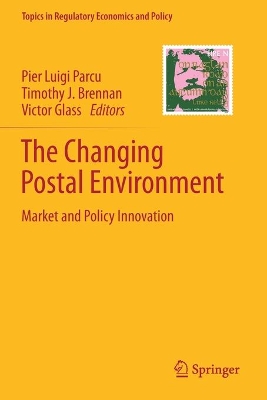
This book addresses major issues facing postal and delivery services throughout the world. Worldwide, there is currently a considerable amount of interest in postal and delivery economics. The industry is reacting to a state of near crisis and is implementing different drastic changes.
The European Commission and member States are still wrestling with the problem of how to implement entry liberalization into postal markets, how to address digital competition, and how to maintain the Universal Service Obligation (USO). Digitalization, technological development and online platforms are strongly affecting both the way postal and delivery operators are managing their services, as well as their role on the market.
Strong emphasis was attributed to the assets of Postal Operators (POs) and their added value in the digital age, as well as on new business strategies. This volume presents original essays by prominent researchers in the field, selected and edited from papers presented at the 27th Conference on Postal and Delivery Economics held in Dublin, Ireland, 22-25 May, 2019. Topics addressed by this volume include the fragmentation of the postal supply chain, blockchain and digital postal services, and the fading of traditional postal market boundaries.
This book will be a useful tool not only for graduate students and professors, but also for postal administrations, consulting firms, and federal government departments.
| ISBN: | 9783030345341 |
| Publication date: | 7th April 2021 |
| Author: | Pier Luigi Parcu |
| Publisher: | Springer Nature Switzerland AG |
| Format: | Paperback |
| Pagination: | 360 pages |
| Series: | Topics in Regulatory Economics and Policy |
| Genres: |
Economics of industrial organization Political economy Welfare economics |
This book addresses major issues facing postal and delivery services throughout the world. Worldwide, there is currently a considerable amount of interest in postal and delivery economics.
The Changing Postal Environment features in the following genres: Economics of industrial organization, Political economy, Welfare economics
Paperback, Hardback. £107.99, down from the £119.99 cover price. Not Available.
The Changing Postal Environment was written by Pier Luigi Parcu and published by Springer Nature Switzerland AG
The Changing Postal Environment has 360 pages
Yes it is part of Topics in Regulatory Economics and Policy series
£107.99, reduced from £119.99. Not Available.