

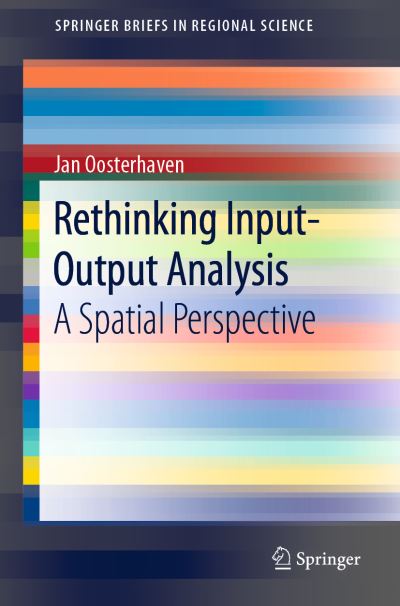
This book highlights the social, economic and environmental importance of the mutual relations between industries in the same and in different regions and nations, and demonstrates how to model these relations using regional, interregional and international input-output (IO) models. It enables readers familiar with standard matrix algebra to extend these basic IO models with endogenous household expenditures, to employ supply-use tables (SUTs) that explicitly distinguish the products used and sold by industry, and to use Social Accounting Matrices (SAMs) that detail the generation, redistribution and spending of income.
In addition to the standard demand-driven IO quantity model and its accompanying cost-push IO price model, the book also discusses the economic assumptions and usefulness of the supply-driven IO quantity model and its accompanying revenue-pull IO price model. The final chapters highlight three main applications of the IO model: (1) economic impact analysis of negative supply shocks as caused by, for example, natural disasters, (2) linkages, key sector and cluster analysis, (3) structural decomposition analysis, especially of regional, interregional and international growth, and demonstrate the strengths and weaknesses of these IO applications.
This book appeals to economists and planners as well as scholars of regional and spatial science.
| ISBN: | 9783030334468 |
| Publication date: | 27th November 2019 |
| Author: | Jan Oosterhaven |
| Publisher: | Springer an imprint of Springer International Publishing |
| Format: | Paperback |
| Pagination: | 116 pages |
| Series: | SpringerBriefs in Regional Science |
| Genres: |
Political economy Environmental economics Economic geography Regional / International studies Economics of industrial organization |
This book highlights the social, economic and environmental importance of the mutual relations between industries in the same and in different regions and nations, and demonstrates how to model these relations using regional, interregional and international input-output (IO) models. It enables readers familiar with standard matrix algebra to extend these basic IO models with endogenous household expenditures, to employ supply-use tables (SUTs) that explicitly distinguish the products used and sold by industry, and to use Social Accounting Matrices (SAMs) that detail the generation, redistribution and spending of income.
Rethinking Input-Output Analysis features in the following genres: Political economy, Environmental economics, Economic geography, Regional / International studies, Economics of industrial organization
Paperback, Hardback. Not Available.
Rethinking Input-Output Analysis was written by Jan Oosterhaven and published by Springer an imprint of Springer International Publishing
Rethinking Input-Output Analysis has 116 pages
Yes it is part of SpringerBriefs in Regional Science series