

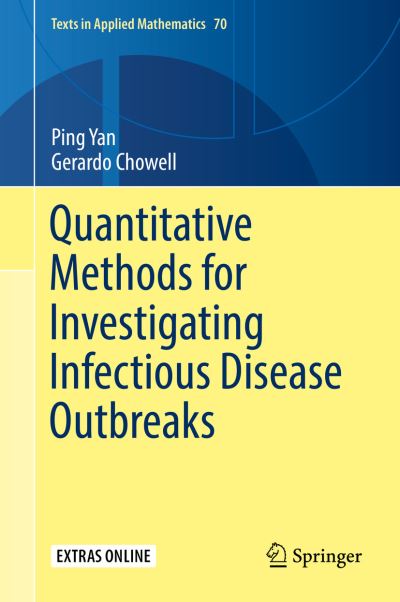
This book provides a systematic treatment of the mathematical underpinnings of work in the theory of outbreak dynamics and their control, covering balanced perspectives between theory and practice including new material on contemporary topics in the field of infectious disease modelling. Specifically, it presents a unified mathematical framework linked to the distribution theory of non-negative random variables; the many examples used in the text, are introduced and discussed in light of theoretical perspectives.
The book is organized into 9 chapters: The first motivates the presentation of the material on subsequent chapters; Chapter 2-3 provides a review of basic concepts of probability and statistical models for the distributions of continuous lifetime data and the distributions of random counts and counting processes, which are linked to phenomenological models. Chapters 4 focuses on dynamic behaviors of a disease outbreak during the initial phase while Chapters 5-6 broadly cover compartment models to investigate the consequences of epidemics as the outbreak moves beyond the initial phase. Chapter 7 provides a transition between mostly theoretical topics in earlier chapters and Chapters 8 and 9 where the focus is on the data generating processes and statistical issues of fitting models to data as well as specific mathematical epidemic modeling applications, respectively.
This book is aimed at a wide audience ranging from graduate students to established scientists from quantitatively-oriented fields of epidemiology, mathematics and statistics. The numerous examples and illustrations make understanding of the mathematics of disease transmission and control accessible.
Furthermore, the examples and exercises, make the book suitable for motivated students in applied mathematics, either through a lecture course, or through self-study. This text could be used in graduate schools or special summer schools covering research problems in mathematical biology.
| ISBN: | 9783030219222 |
| Publication date: | 30th August 2019 |
| Author: | Ping Yan, Gerardo Chowell |
| Publisher: | Springer an imprint of Springer International Publishing |
| Format: | Hardback |
| Pagination: | 354 pages |
| Series: | Texts in Applied Mathematics |
| Genres: |
Applied mathematics Mathematical modelling Computational biology / bioinformatics Epidemiology and Medical statistics Diseases and disorders Maths for engineers |
This book provides a systematic treatment of the mathematical underpinnings of work in the theory of outbreak dynamics and their control, covering balanced perspectives between theory and practice including new material on contemporary topics in the field of infectious disease modelling. Specifically, it presents a unified mathematical framework linked to the distribution theory of non-negative random variables; the many examples used in the text, are introduced and discussed in light of theoretical perspectives.
Quantitative Methods for Investigating Infectious Disease Outbreaks features in the following genres: Applied mathematics, Mathematical modelling, Computational biology / bioinformatics, Epidemiology and Medical statistics, Diseases and disorders, Maths for engineers
Paperback, Hardback. £53.99, down from the £59.99 cover price. Not Available.
Quantitative Methods for Investigating Infectious Disease Outbreaks was written by Ping Yan, Gerardo Chowell and published by Springer an imprint of Springer International Publishing
Quantitative Methods for Investigating Infectious Disease Outbreaks has 354 pages
Yes it is part of Texts in Applied Mathematics series
£53.99, reduced from £59.99. Not Available.