

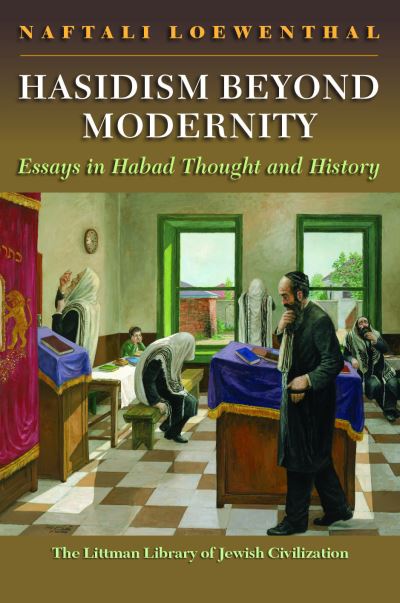
The Habad school of hasidism is distinguished today
from other hasidic groups by its famous emphasis on outreach, on messianism, and
on empowering women. Hasidism Beyond Modernity provides a critical,
thematic study of the movement from its beginnings, showing how its unusual qualities
evolved. Topics investigated include the theoretical underpinning of the
outreach ethos; the turn towards women in the twentieth century; new attitudes
to non-Jews; the role of the individual in the hasidic collective; spiritual
contemplation in the context of modernity; the quest for inclusivism in the
face of prevailing schismatic processes;
messianism in both spiritual and political forms; and the direction of the
movement after the passing of its seventh rebbe,
Rabbi Menachem Mendel Schneerson, in 1994. Attention is given to many contrasts:
pre-modern, modern, and postmodern conceptions of Judaism; the clash between maintaining
an enclave and outreach models of Jewish society; particularist and
universalist trends; and the subtle interplay of mystical faith and rationality.
Some of the chapters are new; others, published in an earlier form, have been
updated to take account of recent scholarship. This book presents an in-depth
study of an intriguing movement which takes traditional hasidism beyond
modernity.
| ISBN: | 9781906764708 |
| Publication date: | 18th December 2019 |
| Author: | Naftali Loewenthal |
| Publisher: | The Littman Library of Jewish Civilization an imprint of Liverpool University Press |
| Format: | Hardback |
| Pagination: | 456 pages |
| Series: | The Littman Library of Jewish Civilization |
| Genres: |
Judaism Judaism: branches and groups Judaism: life and practice History of religion |
The Habad school of hasidism is distinguished today from other hasidic groups by its famous emphasis on outreach, on messianism, and on empowering women. Hasidism Beyond Modernity provides a critical, thematic study of the movement from its beginnings, showing how its unusual qualities evolved.
Hasidism Beyond Modernity features in the following genres: Judaism, Judaism: branches and groups, Judaism: life and practice, History of religion
Hardback. Not Available.
Hasidism Beyond Modernity was written by Naftali Loewenthal and published by The Littman Library of Jewish Civilization an imprint of Liverpool University Press
Hasidism Beyond Modernity has 456 pages
Yes it is part of The Littman Library of Jewish Civilization series