

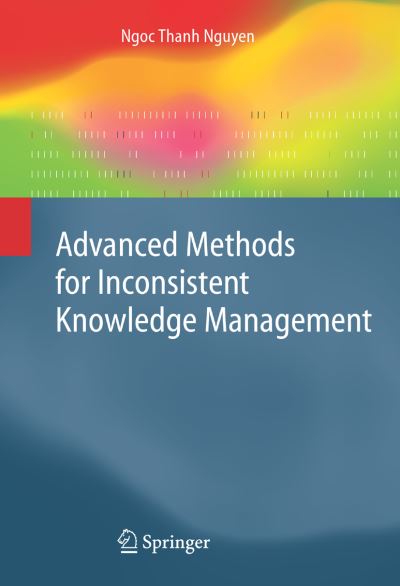
Nowadays in the knowledge society, each member deals with a number of tasks related to knowledge management. The most often realized tasks are: decision making, knowledge integration, selection, and retrieval. In all these tasks one has to solve inconsistency of knowledge.
Inconsistency is a feature of knowledge which is characterized by the lack of possibility for inference processes. Therefore, solving inconsistency of knowledge is a basic and very essential subtask in many tasks of knowledge management. The whole management process may become impossible if the incons- tency is not resolved.
This book presents a set of methods for resolving inconsistency of kn- ledge. It originally treats the inconsistency on two levels, syntactic and semantic, and proposes methods for processing inconsistency on these levels. The methods proposed here are consensus based.
They are worked out on the basis of mathematical models for representing inconsistency as well as tools for measuring and evaluating the degree of inconsistency, defined by the author. The presented material shows that the solution of inconsistency is str- gly related to knowledge integration processes. Therefore, along with - consistency resolution tools, the author proposes algorithms for knowledge integration, such as ontology integration, or agent knowledge states in- gration.
The author has put across a deep and valuable analysis of the p- posed models by proving a number of interesting and useful theorems and remarks. Owing to these analysis results one can decide to use the worked out algorithms for concrete practical situations.
| ISBN: | 9781846288883 |
| Publication date: | 28th September 2007 |
| Author: | Ngoc Thanh NguyÒõen |
| Publisher: | Springer an imprint of Springer London |
| Format: | Hardback |
| Pagination: | 351 pages |
| Series: | Advanced Information and Knowledge Processing |
| Genres: |
Business strategy Business mathematics and systems Algorithms and data structures Data warehousing Information retrieval Artificial intelligence Applied computing |
Nowadays in the knowledge society, each member deals with a number of tasks related to knowledge management. The most often realized tasks are: decision making, knowledge integration, selection, and retrieval.
Advanced Methods for Inconsistent Knowledge Management features in the following genres: Business strategy, Business mathematics and systems, Algorithms and data structures, Data warehousing, Information retrieval, Artificial intelligence, Applied computing
Hardback. Not Available.
Advanced Methods for Inconsistent Knowledge Management was written by Ngoc Thanh NguyÒõen and published by Springer an imprint of Springer London
Advanced Methods for Inconsistent Knowledge Management has 351 pages
Yes it is part of Advanced Information and Knowledge Processing series