

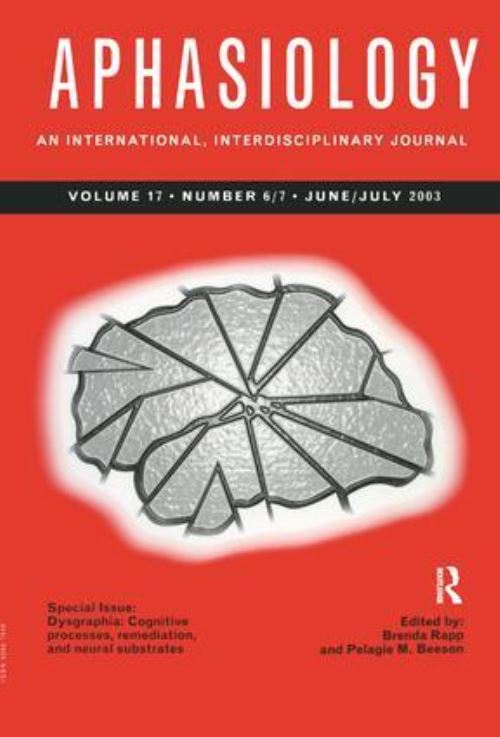
Written language permeates virtually every aspect of modern society and literacy plays a central role in determining the economic and personal success of the individual. However, while the importance of written language comprehension (reading) is generally acknowledged, the significance of written language expression (spelling) is often overlooked. As a result, there has been relatively little research directed at understanding the cognitive and neural bases of written language production.
Equally surprising is that the treatment of written language deficits is largely neglected in the training of clinical aphasiologists and speech and language pathologists. This is particularly problematic given the evidence that written language skills may be amenable to treatment even when spoken language deficits are not. Thus the successful treatment of acquired dsygraphia may provide a means of communication for individuals who otherwise may be severely limited in their communication abilities.
This volume seeks to provide an overview of the state-of-the-field by bringing together a collection of research papers concerning the treatment of written language deficits in individuals with acquired dysgraphia, along with investigations of the cognitive processes and neural substrates of written language production. In addition, the inclusion, within this volume, of papers investigating the cognitive processing and neural substrates of non-alphabetic written language codes such as Chinese and Japanese, provides an impetus to consider the ways in which the cognitive processes and neural substrates responsible for written language processing may be similar or different across languages and language codes.
The broadening of the domain of investigation in this manner can only lead to a deeper understanding of written language processing, its neural bases and the methods that can be successfully used in facilitating its recovery.
| ISBN: | 9781841699486 |
| Publication date: | 3rd July 2003 |
| Author: | Brenda Rapp, Pelagie M Beeson |
| Publisher: | Psychology Press an imprint of Taylor & Francis |
| Format: | Paperback |
| Pagination: | 164 pages |
| Series: | Special Issues of Aphasiology |
| Genres: |
Cognition and cognitive psychology Physiological and neuro-psychology, biopsychology |
Written language permeates virtually every aspect of modern society and literacy plays a central role in determining the economic and personal success of the individual. However, while the importance of written language comprehension (reading) is generally acknowledged, the significance of written language expression (spelling) is often overlooked.
Dysgraphia features in the following genres: Cognition and cognitive psychology, Physiological and neuro-psychology, biopsychology
Paperback. £34.19, down from the £37.99 cover price. Not Available.
Dysgraphia was written by Brenda Rapp, Pelagie M Beeson and published by Psychology Press an imprint of Taylor & Francis
Dysgraphia has 164 pages
Yes it is part of Special Issues of Aphasiology series
£34.19, reduced from £37.99. Not Available.