

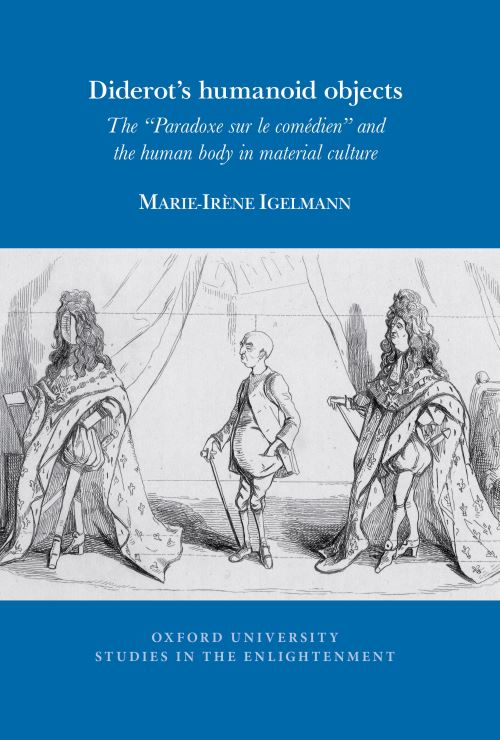
Diderot was one of the most important philosophical thinkers of the French Enlightenment. His works are also milestones in theater history. This book is the first study to contextualize Diderot's acting theory, as presented in the Paradoxe sur le comédien, within the broader landscape of eighteenth-century material culture, centering on four humanoid objects: the automaton, the statue, the jumping jack, and the mannequin, which Diderot employs as metaphors to articulate his ideas on acting. The book shows how the metaphorical use of these four objects is shaped by their material characteristics and distinct functionality in everyday life.
Diderot's humanoid objects demonstrates that a deep dive into eighteenth-century material culture is necessary to fully acknowledge Diderot's aesthetic and anthropological concept of the ideal actor/actress. Thus, the book recovers aspects of Diderot's acting theory that have been eclipsed by subsequent theater practitioners and theoreticians interested in humanoid objects as role models for actors (such as Kleist, Craig, Meyerhold or Schlemmer). It also sheds new light on the humanoid objects present in Diderot's novels and Salons, thereby offering fresh insights into how people in the eighteenth century understood themselves in relation to mechanisms or machines - be it in cultural, societal or political contexts.
| ISBN: | 9781836245285 |
| Publication date: | 11th November 2025 |
| Author: | MarieIrène Igelmann |
| Publisher: | Voltaire Foundation an imprint of Liverpool University Press |
| Format: | Paperback |
| Pagination: | 264 pages |
| Series: | Oxford University Studies in the Enlightenment |
| Genres: |
Society and culture: general European history: Reformation Social and cultural history History of Performing Arts |
Diderot was one of the most important philosophical thinkers of the French Enlightenment. His works are also milestones in theater history.
Diderot's Humanoid Objects features in the following genres: Society and culture: general, European history: Reformation, Social and cultural history, History of Performing Arts
Paperback. Not Available.
Diderot's Humanoid Objects was written by MarieIrène Igelmann and published by Voltaire Foundation an imprint of Liverpool University Press
Diderot's Humanoid Objects has 264 pages
Yes it is part of Oxford University Studies in the Enlightenment series