

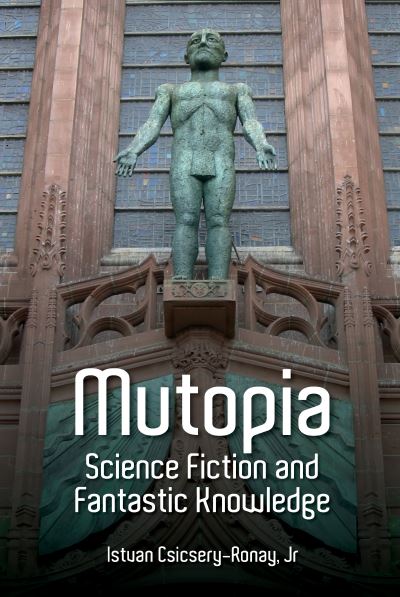
The Enlightenment's project of establishing scientific proof for the unity of the universe led instead to the fragmentation of knowledge. The culture of certainty mutated into a culture of conjecture and speculative supplements as the image of a unified cosmos mutated into a patchwork totality. In the process, the pursuit of knowledge developed a symbiotic association with science fiction. While sf has often provided concrete ideas adopted by the knowledge faculties, equally important is the way science-fictional counterfactual world building - science fiction's "fantastic knowledge" - has intersected with rational speculation in all fields of knowledge. As a result, the dream of a completed, rationally engineered utopia has evolved into the image of "mutopia," in which the objects of knowledge, the process of knowing, and the science-fictional imagination itself are expected to undergo constant transformation. The essays in Mutopia address the science-fictional imagination's relevance for scientific modeling, critical theory, the deconstruction of the future, the future of religion, the future of nations, the imagination of empire, the construction of aliens, the future of science fiction itself, and the transformation of utopia into mutopia. Written over many years by a leading scholar of science fiction, the essays are revised and expanded for republication in this collection, alongside new commentary that places them in an updated context.
| ISBN: | 9781836244004 |
| Publication date: | 4th March 2025 |
| Author: | Istvan CsicseryRonay |
| Publisher: | Liverpool University Press |
| Format: | Paperback |
| Pagination: | 256 pages |
| Series: | Liverpool Science Fiction Texts and Studies |
| Genres: |
Literary studies: fiction, novelists and prose writers Literary studies: c 1900 to c 2000 Literary studies: from c 2000 |
The Enlightenment's project of establishing scientific proof for the unity of the universe led instead to the fragmentation of knowledge. The culture of certainty mutated into a culture of conjecture and speculative supplements as the image of a unified cosmos mutated into a patchwork totality.
Mutopia features in the following genres: Literary studies: fiction, novelists and prose writers, Literary studies: c 1900 to c 2000, Literary studies: from c 2000
Paperback, Hardback. Not Available.
Mutopia was written by Istvan CsicseryRonay and published by Liverpool University Press
Mutopia has 256 pages
Yes it is part of Liverpool Science Fiction Texts and Studies series