

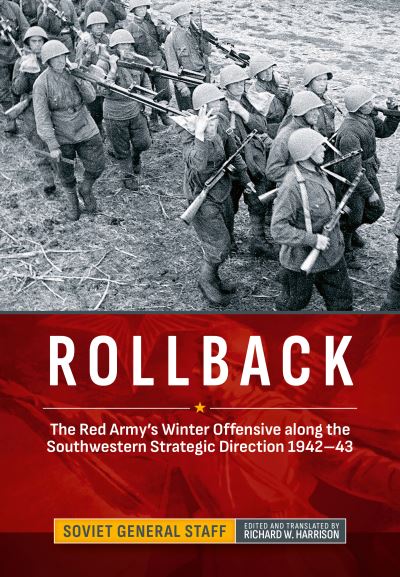
Rollback: The Red Army's Winter Offensive along the Southwestern Strategic Direction, 1942-43 covers the period from mid-December 1942 to mid-February 1943, one of the most critical periods of the war on the Eastern Front. It was here that following the encirclement of an entire German army at Stalingrad, the Soviets sought to take advantage of the ruptured Axis front in southern Russia to finish off the Germans' Italian and Hungarian allies and liberate the economically vital areas of eastern Ukraine.
This study is drawn from a number of wartime and postwar articles, published by the General Staff's directorate for the study of wartime experience. Also featured are documents relating to the operational-strategic conduct of the various operations, which were compiled and published after the fall of the Soviet Union.
Several articles deal with the preparation for and conduct of the Southwestern Front's Middle Don operation of December 1942. Originally intended as an ambitious offensive to cut off the German forces in the North Caucasus by driving on to Rostov, the operation was later reoriented to meet the threat of the German effort to relieve Stalingrad. The offensive not only accomplished its objective of turning back the German attack, thus dooming the Stalingrad garrison, but also destroyed the Italian army in the East as well.
The Soviet Voronezh Front then struck further up the Don River, and in the Ostrogozhsk-Rossosh' operation destroyed what remained of the Italian forces in the area, as well as the Hungarian army. This enabled the Red Army to capture Khar'kov and push nearly to the Dnepr River by mid-February, before being thrown back by a skillful German counteroffensive.
The territorial results of this operation set the stage for the front's subsequent Voronezh-Kastornoe operation, which enabled the Soviets to push as far west as Kursk before exhaustion and growing German resistance brought the offensive to a halt. Further to the south, the Soviets were able to capture Voroshilovgrad and penetrate into the industrial Donets Basin.
The book also contains a detailed Soviet examination of the employment of tank and mechanized corps during the campaign. The conclusions reached here had a direct bearing on the restructuring of the Red Army's tank armies in time for the summer campaign of 1943.
| ISBN: | 9781806720637 |
| Publication date: | 17th September 2025 |
| Author: | Richard W Harrison |
| Publisher: | Helion & Company an imprint of Helion and Company |
| Format: | Hardback |
| Pagination: | 412 pages |
| Series: | Association of the United States Army (AUSA) Publications |
| Genres: |
Second World War Ordnance, weapons technology Weapons and equipment History of other geographical groupings and regions Military history |
Rollback: The Red Army's Winter Offensive along the Southwestern Strategic Direction, 1942-43 covers the period from mid-December 1942 to mid-February 1943, one of the most critical periods of the war on the Eastern Front. It was here that following the encirclement of an entire German army at Stalingrad, the Soviets sought to take advantage of the ruptured Axis front in southern Russia to finish off the Germans' Italian and Hungarian allies and liberate the economically vital areas of eastern Ukraine.This study is drawn from a number of wartime and postwar articles, published by the General Staff's directorate for the study of wartime experience.
Rollback features in the following genres: Second World War, Ordnance, weapons technology, Weapons and equipment, History of other geographical groupings and regions, Military history
Hardback, Paperback. £33.75, down from the £37.50 cover price. In Stock.
Rollback was written by Richard W Harrison and published by Helion & Company an imprint of Helion and Company
Rollback has 412 pages
Yes it is part of Association of the United States Army (AUSA) Publications series
£33.75, reduced from £37.50. In Stock.