

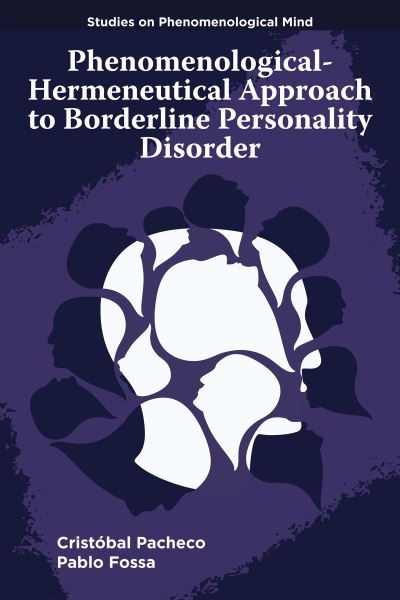
Phenomenological-Hermeneutical Approach to Borderline Personality Disorder explores the subjective experience of individuals living with borderline personality disorder (BPD) through phenomenological and hermeneutic lenses. This volume bridges the gap between psychological theory and lived experience, offering a nuanced perspective on emotional instability, relational disturbances, and the profound existential challenges faced by individuals with BPD. By incorporating methods such as Interpretative Phenomenological Analysis (IPA) and micro-phenomenology, the authors propose a comprehensive framework to uncover the complex inner dynamics of this condition.
Dr. Cristóbal Pacheco and Dr. Pablo Fossa approach BPD from multiple perspectives, examining the instability at the core of the condition, the temporal and spatial structures of emotional turbulence, and the centrality of empathy in grasping subjective realities. The text also explores hermeneutics as a means to interpret and reveal deeper layers of meaning, encouraging readers to understand BPD not merely as a diagnosis, but as a complex and multifaceted human experience.
This book is an essential resource for psychologists, clinicians, researchers, and students seeking a deeper understanding of BPD, as well as for those interested in phenomenological and hermeneutic approaches. It challenges conventional paradigms by centering the lived experiences of individuals and advocates for a more compassionate and holistic approach to psychological care.
| ISBN: | 9781805922827 |
| Publication date: | 8th December 2025 |
| Author: | Cristóbal Pacheco, Pablo Fossa |
| Publisher: | Emerald Publishing an imprint of Emerald Publishing Limited |
| Format: | Hardback |
| Pagination: | 216 pages |
| Series: | Studies on Phenomenological Mind |
| Genres: |
Psychological theory, systems, schools and viewpoints Psychology: the self, ego, identity, personality Parapsychological studies |
Phenomenological-Hermeneutical Approach to Borderline Personality Disorder explores the subjective experience of individuals living with borderline personality disorder (BPD) through phenomenological and hermeneutic lenses. This volume bridges the gap between psychological theory and lived experience, offering a nuanced perspective on emotional instability, relational disturbances, and the profound existential challenges faced by individuals with BPD. By incorporating methods such as Interpretative Phenomenological Analysis (IPA) and micro-phenomenology, the authors propose a comprehensive framework to uncover the complex inner dynamics of this condition.
Dr. Cristóbal Pacheco and Dr. Pablo Fossa approach BPD from multiple perspectives, examining the instability at the core of the condition, the temporal and spatial structures of emotional turbulence, and the centrality of empathy in grasping subjective realities. The text also explores hermeneutics as a means to interpret and reveal deeper layers of meaning, encouraging readers to understand BPD not merely as a diagnosis, but as a complex and multifaceted human experience.
This book is an essential resource for psychologists, clinicians, researchers, and students seeking a deeper understanding of BPD, as well as for those interested in phenomenological and hermeneutic approaches. It challenges conventional paradigms by centering the lived experiences of individuals and advocates for a more compassionate and holistic approach to psychological care.
Phenomenological-Hermeneutical Approach to Borderline Personality Disorder features in the following genres: Psychological theory, systems, schools and viewpoints, Psychology: the self, ego, identity, personality, Parapsychological studies
Phenomenological-Hermeneutical Approach to Borderline Personality Disorder is available in Hardback, Paperback
Phenomenological-Hermeneutical Approach to Borderline Personality Disorder was written by Cristóbal Pacheco, Pablo Fossa and published by Emerald Publishing an imprint of Emerald Publishing Limited
Phenomenological-Hermeneutical Approach to Borderline Personality Disorder has 216 pages
Yes it is part of Studies on Phenomenological Mind series