

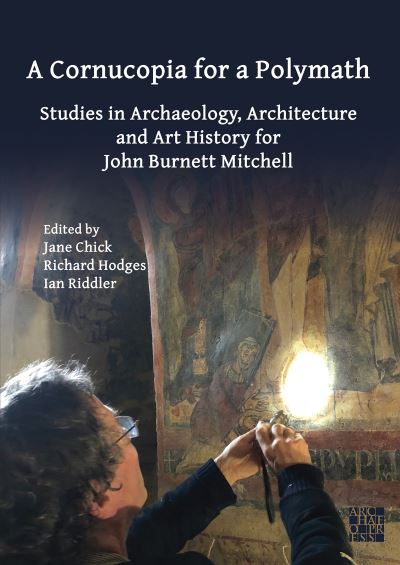
This book celebrates John Mitchell on his 80th birthday. The festschrift brings together some of his army of undergraduate and graduate students, his fellow-travellers in the bi-ways of art history, his companions and colleagues on archaeological excavations and also a few admirers who have simply revelled in his friendship. The breadth of papers speaks volumes. John Mitchell describes himself as a jobbing art historian. It is a modest explanation to his peers as to why, while still working on the art historical canon from Anglo-Saxon bibles and crosses to Rembrandt, he has ventured far and wide into a field that he likes to describe, with a chuckle, as knick-knacks. This cornucopia of interests, as this volume attests, is quite simply remarkable. He has mastered Roman mosaics, late antique architecture and amulets, Umayadd painting, the familiar and unfamiliar quotidian objects of the early Middle Ages from nails to trap-door hinges and, if occasion demanded, flints used in Lombard contexts, as well as coins of all periods. It is not at all an exaggeration to describe him as a polymath. His excitement about the past is infectious. These are the hallmarks of someone who thrillingly pursues meaning in everything as far as it is possible. No matter what the object might be, his eye dwells longingly on its creation and its wider social significance. In sum, John Mitchell defies categorisation in the age of the corporate academy.
| ISBN: | 9781805830344 |
| Publication date: | 11th September 2025 |
| Author: | John Mitchell |
| Publisher: | Archaeopress Archaeology an imprint of Archaeopress Publishing Ltd |
| Format: | Paperback |
| Pagination: | 412 pages |
| Genres: |
Archaeology by period / region History of art |
This book celebrates John Mitchell on his 80th birthday. The festschrift brings together some of his army of undergraduate and graduate students, his fellow-travellers in the bi-ways of art history, his companions and colleagues on archaeological excavations and also a few admirers who have simply revelled in his friendship.
A Cornucopia for a Polymath features in the following genres: Archaeology by period / region, History of art
Paperback. £67.50, down from the £75.00 cover price. Not Available.
A Cornucopia for a Polymath was written by John Mitchell and published by Archaeopress Archaeology an imprint of Archaeopress Publishing Ltd
A Cornucopia for a Polymath has 412 pages
£67.50, reduced from £75.00. Not Available.