

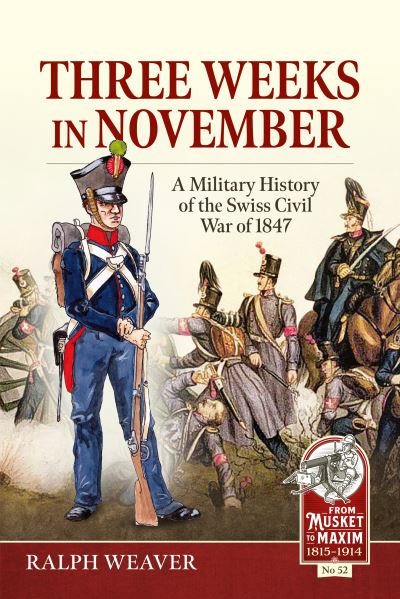
The political phenomenon known as the 'Springtime of the Nations' swept through Europe in 1848, toppling thrones, forcing old autocratic regimes to grant constitutions to the people and bringing street fighting and large scale campaigns to cities and states across the continent. What is not generally known is that a precursor to these events had already taken place in the centre of Europe in the Alpine valleys of the collection of independent states known collectively as Switzerland. In November 1847, twelve of the Swiss cantons went to war with seven other cantons over the future of the country. The campaign lasted just three weeks, with only a few hundred casualties and ended with the establishment of the modern Swiss state we have today. If it had not ended so quickly it is likely that France, Austria and Prussia would have become involved, which would have led to a European-wide war.
This book is unique in that it concentrates on the military aspects of this episode in history. As well as an outline of the campaign itself, it covers the strengths and organisation of each canton; in 1847 each was a separate state with its own army. Included are chapters on the uniforms of the cantons' armies, their battle flags, weapons and distinguishing badges.
The major battle of the war, at Gislikon (modern Gisikon), a small village with a strategic river crossing, just north of the city of Luzern, is treated in detail. As well as the general picture, individual soldiers' stories illustrate the combat techniques of the period.
Biographies are given of some of the leading gures from both sides of the conflict, which demonstrate the European dimension. Many served in French, Dutch and Neapolitan armies before taking appointments in the Swiss canton armies. To compliment the text the book is well illustrated with a mixture of contemporary pictures, in colour and black and white, and also specially produced colour plates of Swiss canton uniforms and flags.
So that the reader can follow the campaign, maps from official Swiss sources are included. Orders of battle for all the cantons and detailed orders of battle for the main action at Gisikon are also provided.
| ISBN: | 9781804518496 |
| Publication date: | 23rd March 2025 |
| Author: | Ralph Weaver |
| Publisher: | Helion & Company an imprint of Helion and Company |
| Format: | Paperback |
| Pagination: | 116 pages |
| Series: | From Musket to Maxim 1815-1914 |
| Genres: |
Military history Ordnance, weapons technology Militaria, arms and armour Weapons and equipment General and world history European history |
The political phenomenon known as the 'Springtime of the Nations' swept through Europe in 1848, toppling thrones, forcing old autocratic regimes to grant constitutions to the people and bringing street fighting and large scale campaigns to cities and states across the continent. What is not generally known is that a precursor to these events had already taken place in the centre of Europe in the Alpine valleys of the collection of independent states known collectively as Switzerland.
Three Weeks in November features in the following genres: Military history, Ordnance, weapons technology, Militaria, arms and armour, Weapons and equipment, General and world history, European history
Paperback. £22.50, down from the £25.00 cover price. In Stock.
Three Weeks in November was written by Ralph Weaver and published by Helion & Company an imprint of Helion and Company
Three Weeks in November has 116 pages
Yes it is part of From Musket to Maxim 1815-1914 series
£22.50, reduced from £25.00. In Stock.