

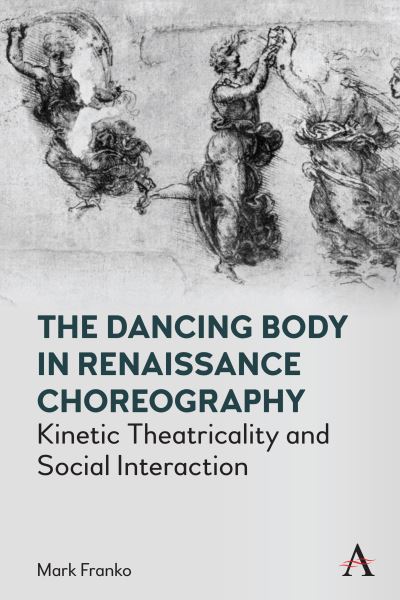
The Dancing Body in Renaissance Choreography problematizes the absence of the dancing body in treatises in order to reconstruct it through a series of intertextual readings triggered by Thoinot Arbeau's definition of dance in his 1589 dance treatise, Orchesographie. The notion of the intertext as elaborated by Michael Riffaterre is used to understand a series of relationships between dance and other activities within which the historical dancing body emerges to the light of day. Arbeau's discussion of dance as a mute rhetoric in the demonstrative genre points to the intertext of Quintilian's The Oratorical Institution where the genus demonstrativum is explained as epideixis, the goal of which is to inspire confidence and charm the audience. The second intertext explored is that of civility as found in courtesy books where the posture of the body and the parameters of movement are outlined, converging in the gesture of the révérence. The categories of pose and movement are then read into the structure of the basse danse, the quintessential courtly social dance of the period. The relation of pose to movement or of stillness to mobility is further theorized through the terms of earlier Italian treatises, specifically in terms of fantasmata as used by Domenico da Piacenza.
| ISBN: | 9781785278013 |
| Publication date: | 1st March 2022 |
| Author: | Mark Franko |
| Publisher: | Anthem Press |
| Format: | Hardback |
| Pagination: | 160 pages |
| Series: | Anthem Studies in Theatre and Performance |
| Genres: |
Dance Ballet Literary theory |
The Dancing Body in Renaissance Choreography problematizes the absence of the dancing body in treatises in order to reconstruct it through a series of intertextual readings triggered by Thoinot Arbeau's definition of dance in his 1589 dance treatise, Orchesographie. The notion of the intertext as elaborated by Michael Riffaterre is used to understand a series of relationships between dance and other activities within which the historical dancing body emerges to the light of day.
The Dancing Body in Renaissance Choreography features in the following genres: Dance, Ballet, Literary theory
Hardback. £80.00. Not Available.
The Dancing Body in Renaissance Choreography was written by Mark Franko and published by Anthem Press
The Dancing Body in Renaissance Choreography has 160 pages
Yes it is part of Anthem Studies in Theatre and Performance series
£80.00. Not Available.