

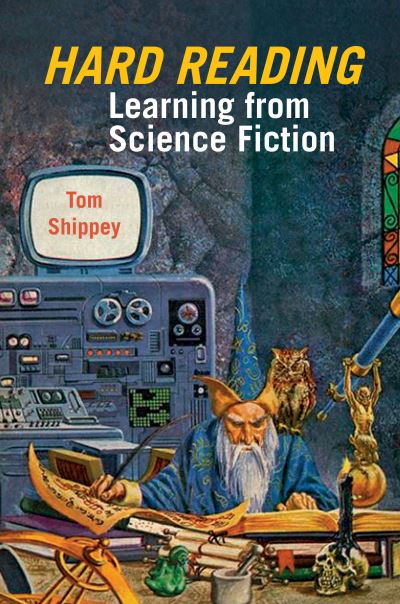
An Open Access edition of this book is available on the Liverpool University Press website and the OAPEN library.
The fifteen essays collected in Hard Reading argue, first, that science fiction has its own internal rhetoric, relying on devices such as neologism, dialogism, semantic shifts, the use of unreliable narrators. It is a "high-information" genre which does not follow the Flaubertian ideal of le mot juste, "the right word", preferring le mot imprévisible, "the unpredictable word". Both ideals shun the facilior lectio, the "easy reading", but for different reasons and with different effects.
The essays argue further that science fiction derives much of its energy from engagement with vital intellectual issues in the "soft sciences", especially history, anthropology, the study of different cultures, with a strong bearing on politics. Both the rhetoric and the issues deserve to be taken much more seriously than they have been in academia, and in the wider world. Each essay is further prefaced by an autobiographical introduction. These explain how the essays came to be written and in what ways they (often) proved controversial. They, and the autobiographical introduction to the whole book, create between them a memoir of what it was like to be a committed fan, from teenage years, and also an academic struggling to find a place, at a time when a declared interest in science fiction and fantasy was the kiss of death for a career in the humanities.
| ISBN: | 9781781382615 |
| Publication date: | 23rd February 2016 |
| Author: | T A Shippey |
| Publisher: | Liverpool University Press |
| Format: | Hardback |
| Pagination: | 351 pages |
| Series: | Liverpool Science Fiction Texts and Studies |
| Genres: |
Literary studies: c 1900 to c 2000 |
An Open Access edition of this book is available on the Liverpool University Press website and the OAPEN library.The fifteen essays collected in Hard Reading argue, first, that science fiction has its own internal rhetoric, relying on devices such as neologism, dialogism, semantic shifts, the use of unreliable narrators. Both the rhetoric and the issues deserve to be taken much more seriously than they have been in academia, and in the wider world.
Hard Reading features in the following genres: Literary studies: c 1900 to c 2000
Hardback. Not Available.
Hard Reading was written by T A Shippey and published by Liverpool University Press
Hard Reading has 351 pages
Yes it is part of Liverpool Science Fiction Texts and Studies series