

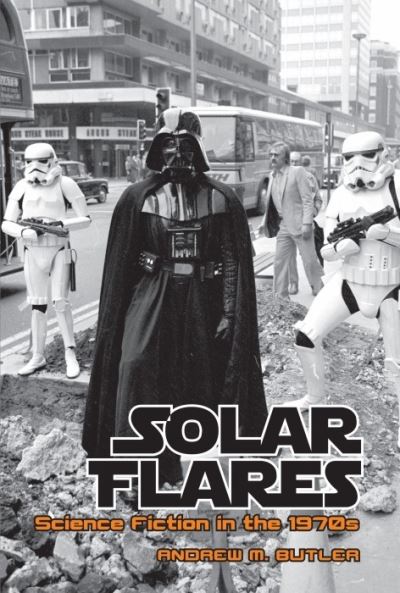
Science fiction produced in the 1970s has long been undervalued, dismissed by Bruce Sterling as "confused, self-involved, and stale." The New Wave was all but over and Cyberpunk had yet to arrive. The decade polarised sf - on the one hand it aspired to be a serious form, addressing issues such as race, Vietnam, feminism, ecology and sexuality, on the other hand it broke box office records with Star Wars, Close Encounters of the Third Kind, Alien and Superman: The Movie.
Across the political spectrum, writers perceived a series of invisible enemies: radicals addressed the ideological structures of racism, sexism, homophobia, colonialism, pollution and capitalism and the possibility of new social structures, whereas conservatives feared the gains made by the civil rights movement, feminism, gay liberation, independence movements, ecology and Marxism and the perceived threats to the nuclear family.
Sf would never be the same again. Beginning with chapters on the First sf and New Wave authors who published during the 1970s, Solar Flares examines the ways in which the genre confronted a new epoch and its own history, including the rise of fantasy, the sf blockbuster, children's sf, pseudoscience and postmodernism. It explores significant figures such as Joanna Russ, Samuel R.
Delany and Octavia Butler. From Larry Niven's Ringworld to Thomas M. Disch's On Wings of Song, from The Andromeda Strain to Flash Gordon and from Doctor Who to Buck Rogers, this book reclaims seventies sf writing, film and television - alongside music and architecture - as a crucial period in the history of science fiction.
| ISBN: | 9781781381175 |
| Publication date: | 1st August 2014 |
| Author: | Andrew M Butler |
| Publisher: | Liverpool University Press |
| Format: | Paperback |
| Pagination: | 302 pages |
| Series: | Liverpool Science Fiction Texts and Studies |
| Genres: |
Literature: history and criticism |
Science fiction produced in the 1970s has long been undervalued, dismissed by Bruce Sterling as "confused, self-involved, and stale." The New Wave was all but over and Cyberpunk had yet to arrive. The decade polarised sf - on the one hand it aspired to be a serious form, addressing issues such as race, Vietnam, feminism, ecology and sexuality, on the other hand it broke box office records with Star Wars, Close Encounters of the Third Kind, Alien and Superman: The Movie.
Solar Flares features in the following genres: Literature: history and criticism
Paperback, Hardback. Not Available.
Solar Flares was written by Andrew M Butler and published by Liverpool University Press
Solar Flares has 302 pages
Yes it is part of Liverpool Science Fiction Texts and Studies series