

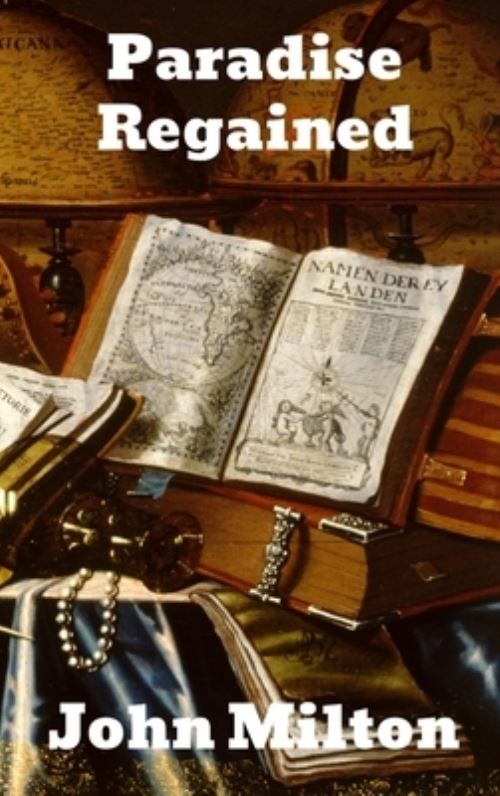
Milton composed Paradise Regained at his cottage in Chalfont St Giles in Buckinghamshire. Paradise Regained is four books long and comprises 2,065 lines; in contrast, Paradise Lost is twelve books long and comprises 10,565 lines. As such, Barbara K. Lewalski has labelled the work a "brief epic".
Whereas Paradise Lost is ornate in style and decorative in its verse, Paradise Regained is carried out in a fairly plain style. Specifically, Milton reduces his use of simile and deploys a simpler syntax in Paradise Regained than he does in Paradise Lost, and this is consistent with Jesus's sublime plainness in his life and teachings (in the epic, he prefers Hebrew psalms to Greek poetry).
Modern editors believe the stylistics of Paradise Regained evince Milton's poetic maturity. No longer is the poet out to dazzle his readers with bombastic verse and lengthy epic similes. This is not to say that the poem bears no affinities with Milton's earlier work, but scholars continue to agree with Northrop Frye's suggestion that Paradise Regained is "practically sui generis" in its poetic execution.
One major concept emphasized throughout Paradise Regained is the idea of reversals. As implied by its title, Milton sets out to reverse the "loss" of Paradise. Thus, antonyms are often found next to each other, reinforcing the idea that everything that was lost in the first epic will be regained by the end of this "brief epic".
Additionally, the work focuses on the idea of "hunger", both in a literal and in a spiritual sense. After wandering in the wilderness for forty days, Jesus is starving for food. Satan, too blind to see any non-literal meanings of the term, offers Christ food and various other temptations, but Jesus continually denies him.
Although Milton's Jesus is remarkably human, an exclusive focus on this dimension of his character obscures the divine stakes of Jesus's confrontation with Satan; Jesus emerges victorious, and Satan falls, amazed.
An interesting anecdote recounted by a Quaker named Thomas Ellwood provides some insight into Paradise Regained's development. After studying Latin with Milton and reading the poet's epic Paradise Lost, Ellwood remarked, "Thou hast said much here of Paradise lost, but what hast thou to say of Paradise found?" Hearing this, Milton at first "sat some time in a muse" before changing the subject; however, sometime thereafter he showed to Ellwood a new manuscript entitled Paradise Regained. Some maintain that although he seemed to express gratitude to Ellwood in a letter, Milton in truth "passed on a friendly if impish fabrication" that made Ellwood feel like the inspiration for the poem.
| ISBN: | 9781774413647 |
| Publication date: | 1st February 1771 |
| Author: | John Milton |
| Publisher: | Binker North an imprint of Brian Westland |
| Format: | Hardback |
| Pagination: | 126 pages |
| Genres: |
Poetry Classic and pre-20th century poetry Poetry by individual poets Sacred texts, scriptures and revered writings Criticism and exegesis of sacred texts Spirituality and religious experience |
Milton composed Paradise Regained at his cottage in Chalfont St Giles in Buckinghamshire. Paradise Regained is four books long and comprises 2,065 lines; in contrast, Paradise Lost is twelve books long and comprises 10,565 lines.
Paradise Regained features in the following genres: Poetry, Classic and pre-20th century poetry, Poetry by individual poets, Sacred texts, scriptures and revered writings, Criticism and exegesis of sacred texts, Spirituality and religious experience
Paperback, Ebook, Hardback. Not Available.
Paradise Regained was written by John Milton and published by Binker North an imprint of Brian Westland
Paradise Regained has 126 pages