

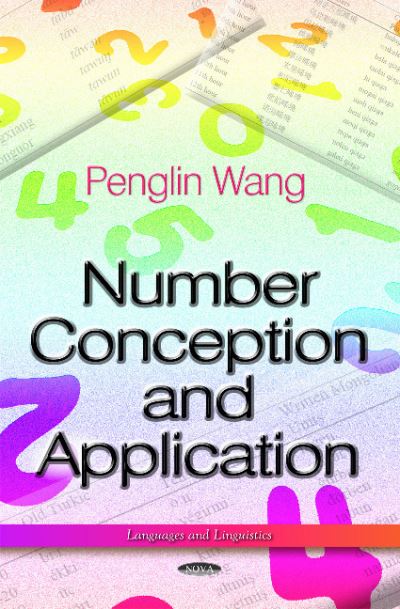
How number words came about? This book offers a trenchant answer to the question, explaining number conception and application slot by slot through a host of Eurasian languages. The cross-linguistic lack of width and depth in numeracy studies, which has existed for a long time, seemed impossible to overcome.
This discouraging situation has now changed dramatically with Dr Penglin Wang's entering the field. This book is designed to investigate the linguistic and semiotic sources of number words, especially the cardinal numbers, in Altaic, Indo-European, and Sino-Tibetan languages and will provide students of numeracy a more cognitive perspective on the problems they may face. The focus is on patterned explanations of each numerical formation as reflected in different languages.
This book contains intellectual merits in four respects. First, it addresses the etymological origins of the numerals, many of which have not received ultimate etymological explanations and even have not yet been discussed. Second, it enriches the existing methodology by launching a strategic shift from the heavy focus on hypothetical reconstructions to the search for cognitive patterns for number conception.
Third, the analyses are interdisciplinary involving linguistics, anthropology, epistemology, semiotics, and history. Fourth, numerical reinterpretation and application is taken fully into consideration in the linguistic formation of numerals across the major language families in Eurasia. In addition, a distinction is made between grammaticality and variability in counting.
The author delves into the theories correlating variability in counting with primitiveness, which was developed during the nineteenth and early twentieth centuries, and argues that variability in counting is not necessarily a primitive phenomenon. Instead, it could be triggered by the then increasing social complexity and progress.
| ISBN: | 9781633217270 |
| Publication date: | 1st December 2014 |
| Author: | Penglin Wang |
| Publisher: | Nova Science Publishers an imprint of Nova Science Publishers, Inc |
| Format: | Hardback |
| Pagination: | 507 pages |
| Series: | Languages and Linguistics |
| Genres: |
Linguistics |
How number words came about? This book offers a trenchant answer to the question, explaining number conception and application slot by slot through a host of Eurasian languages.
Number Conception and Application features in the following genres: Linguistics
Hardback. Not Available.
Number Conception and Application was written by Penglin Wang and published by Nova Science Publishers an imprint of Nova Science Publishers, Inc
Number Conception and Application has 507 pages
Yes it is part of Languages and Linguistics series